Book An Appointment
 Virtual Consultation
Subarachnoid Hemorrhage (SAH): Symptoms, Causes, Diagnosis, and Treatment

FACT CHECKED
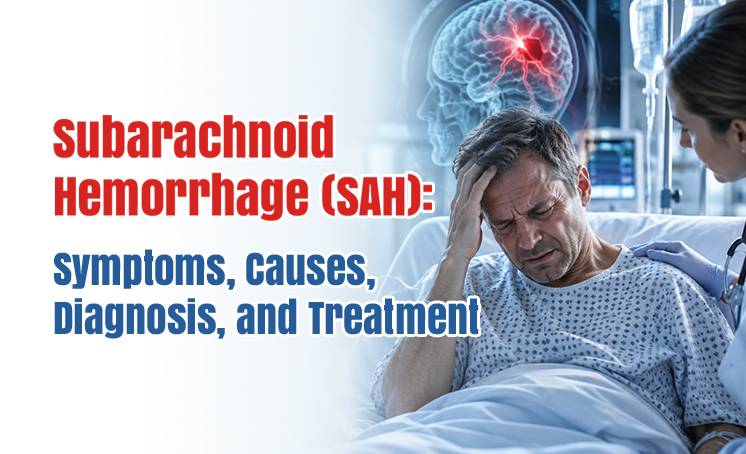
The worst headache of someone’s life doesn’t build up slowly. It usually comes up all at once, like a thunderclap, and is nothing like an ordinary migraine or tension headache.
Subarachnoid hemorrhage is a situation of bleeding into the space around the brain. It’s most often caused by a ruptured aneurysm, a weak spot in a blood vessel that does not give warning. This is a genuine medical emergency, not something to wait out at home.
Studies show close to 45 percent of people don’t survive the first 30 days after a major bleed, and the odds shift heavily based on how fast treatment starts. Dr Nitin Kumar Sethi, Chairman of PSRI Institute of Neurosciences, has managed cases like this for more than 27 years, and his advice is consistent: call emergency services immediately.
What Are The Symptoms Of Subarachnoid Hemorrhage?
There’s one unmistakable sign among subarachnoid hemorrhage (SAH): symptoms, a sudden, severe headache unlike anything felt before. Doctors call it a thunderclap headache, since it peaks within seconds instead of building up gradually.
Call emergency services immediately if any of these appear:
- A sudden, severe headache described as the worst ever experienced
- Neck stiffness along with the headache
- Vomiting that comes on suddenly
- Brief loss of consciousness
- Confusion or trouble staying awake
- Sensitivity to light
- Weakness or numbness on one side of the body
These signs need action right now, say a visit to a multispeciality hospital near me, not a scheduled appointment even a day or two out. Every minute between the bleed and treatment affects how much brain damage occurs.
What Causes A Subarachnoid Hemorrhage?
One thing that sits behind most subarachnoid hemorrhage causes is a ruptured brain aneurysm. An aneurysm is a bulge in a blood vessel wall. Most give no warning until the moment they burst, which is what makes them so hard to catch early.
- Less commonly, the bleeding comes from an arteriovenous malformation, an abnormal tangle of blood vessels present from birth.
- A head injury can cause it too.
- High blood pressure and smoking both raise the risk of an aneurysm forming.
- Heavy alcohol use adds to that risk further.
- A family history of aneurysms raises the risk too, since the tendency to develop one tends to run in families.
How Is Subarachnoid Hemorrhage Diagnosed?
A CT scan is where subarachnoid hemorrhage diagnosis begins, and it’s most accurate within six hours of the headache starting, since blood shows up most clearly on imaging early on.
If the CT scan comes back unclear and suspicion’s still high, a lumbar puncture checks the fluid around the spinal cord for blood a scan might’ve missed. Once a hemorrhage is confirmed, doctors run a cerebral angiogram to find exactly where the aneurysm or abnormal vessel sits, since that location decides what treatment comes next.
All of this at the best hospital in New Delhi happens within hours, inside an emergency department, not across several separate appointments.
How Is Subarachnoid Hemorrhage Treated?
Stopping the bleeding and keeping it from happening again is the entire goal of subarachnoid hemorrhage treatment, and it usually comes down to one of two procedures.
- Surgical clipping places a small clip at the base of the aneurysm. That’s usually enough to seal it off so it can’t fill with blood again.
- Endovascular coiling reaches the aneurysm through a blood vessel and fills it with tiny coils, so the skull doesn’t need to be opened at all.
Alongside either procedure, patients typically spend time in intensive care, since complications can still develop in the days that follow, even after the aneurysm itself is sealed.
- Brain swelling is one risk.
- Vasospasm, when the blood vessels in the brain narrow and cut down blood flow.
- Rebleeding.
Medication controls blood pressure and helps keep the blood vessels from narrowing further. That risk doesn’t end just because surgery is already done.
Get Emergency Neurosurgical Care At PSRI Hospital
A thunderclap headache is never something to wait out. The gap between calling for help right away and waiting even an hour can decide how much of the brain stays undamaged. That gap is the entire reason PSRI Neurosciences team is built the way it is.
As one of the best hospital in New Delhi, PSRI CT and angiography suite runs around the clock, since strokes and bleeds don’t follow office hours. The same team that confirms a bleed on a scan can move a patient straight into clipping or coiling, all on one campus. There’s no transfer between facilities eating into the hours that matter most.
Dr Nitin Kumar Sethi, Chairman, PSRI Institute of Neurosciences says : “I’ve seen patients walk in an hour after symptoms started and patients who waited a full day, hoping it would pass. That gap is usually what decides how the story ends.”
If a headache feels like nothing ever experienced before, call an ambulance immediately. Call +91 84 84 84 84 17 for PSRI Hospital’s emergency neurosciences team.
Frequently Asked Questions
Is a subarachnoid hemorrhage the same as a stroke?
It’s classified as a type of hemorrhagic stroke, caused by bleeding rather than a blocked blood vessel.
Can a subarachnoid hemorrhage be survived?
Survival rates have improved a lot with fast treatment. Some survivors recover fully, others live with lasting effects, and severity is usually what decides which path someone’s on. There’s no way to predict that on day one.
What is a sentinel headache?
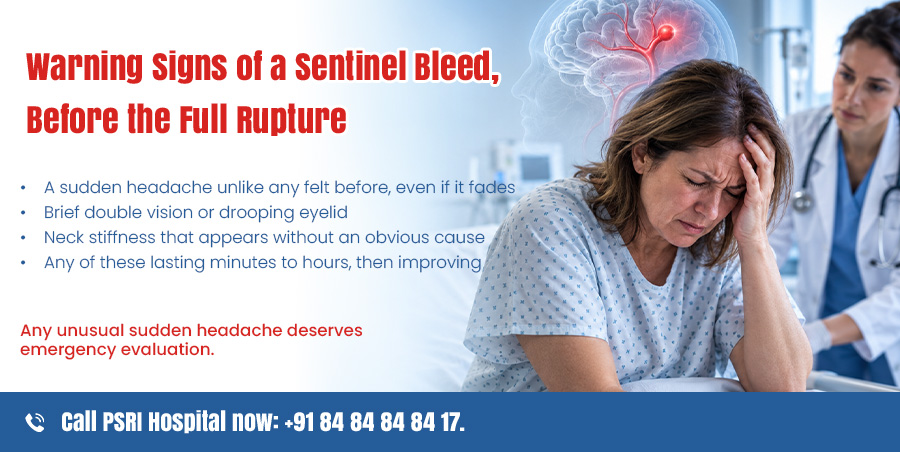
A milder headache from a small, early leak in the same blood vessel, often happening days or weeks before a major rupture.
Can subarachnoid hemorrhage happen without a head injury?
Most cases actually happen spontaneously, from a ruptured aneurysm rather than any kind of injury.