Book An Appointment
 Virtual Consultation

Angiogram (Angiography Test): Procedure, Results & Prep

FACT CHECKED
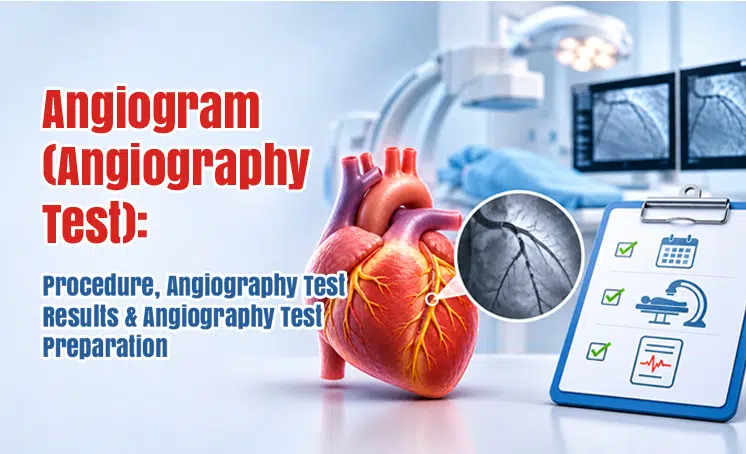
Your doctor said “angiogram” and your mind jumped to the worst. That’s normal. Most people feel scared the night before because they don’t know what will happen.
Here’s the short answer. An angiogram (angiography test) is an X-ray test of your heart arteries. A doctor passes a thin tube, called a catheter, into a wrist or groin artery. Dye flows through it, and X-ray pictures show any narrowing. The test often takes about half an hour.
At PSRI Hospital, Sheikh Sarai, New Delhi, our Cardiac Sciences team works from cath labs, the rooms where doctors perform angiograms, with interventional cardiologists and a 24×7 emergency helpline. We’ve cared for patients since 1996, NABH and NABL accredit us, and our medical team reviewed this guide ON Angiogram (Angiography Test): Procedure. Read on for every step, all about angiography test results & angiography test preparation.
Why Does Your Doctor Want You to Have an Angiogram?
Your doctor wants to see whether a narrowed or blocked artery is behind your symptoms. An angiogram is an X-ray test that shows the inside of your blood vessels. For the heart, doctors call it coronary angiography. Coronary arteries are the vessels that feed your heart muscle. A narrowing in one can cause chest pain or a heart attack.
Doctors usually suggest the test when you have:
- Chest pain or pressure that keeps coming back
- Breathlessness when you walk or climb stairs
- An abnormal ECG or stress test
How Is an Angiogram Procedure Done, Step by Step?
A cardiologist numbs a small area and slides a catheter into an artery. They guide it to your heart and take X-ray pictures while dye flows through. The steps run like this:
- You change into a gown, and a nurse places a drip.
- The doctor numbs your wrist or groin with local anaesthetic.
- A thin catheter goes into the artery and moves up to your heart.
- Dye flows through the catheter.
- An X-ray arm moves around you while you hold still.
- The doctor removes the catheter and presses on the spot to stop bleeding.
Wrist or Groin Entry: What Differs?
Wrist entry is radial access, after the radial artery. Groin entry is femoral access, through the femoral artery in your upper leg. A 2021 pooled analysis of 34 randomised trials in the Journal of Clinical Medicine looked at 30 day outcomes. Major bleeding occurred in 4.1% of radial and 8% of femoral patients. That’s a group result, not a promise for you. Your doctor picks the route that suits your arteries.

Is an Angiogram Painful or Risky?
Most people feel a pinch from the numbing injection and pressure at the entry point, not pain. NHS Inform says you stay awake under local anaesthetic, with a mild sedative sometimes offered. It estimates serious complications at around 2 in 1,000, usually in people with serious underlying heart disease.
Cleveland Clinic lists bruising at the entry point as the most common problem. Bleeding, kidney strain from the dye and dye allergy are less common. Tell your doctor if you have kidney disease, diabetes or any allergy.
If you’re coming with a parent, ask their cardiologist about their blood pressure, sugar and medicines before the day.
How Should You Prepare for an Angiography Test?
Good angiography test preparation follows your cardiologist’s written instructions, so ask for them a few days ahead. Here’s what they usually cover:
- Fasting: NHS Inform says you may skip food and drink for about 6 hours. Follow the time your team gives you.
- Medicines: Bring a full list, including insulin and diabetes tablets. Some blood thinners are paused 3 to 5 days before, according to NHS Inform. Never stop a medicine on your own. Ask first.
- Blood Tests: Your team may check kidney function, since the dye passes through your kidneys.
- What to Bring: Wear loose clothes. Carry old reports, and mention every allergy. Arrange for a family member to take you home.
What Should You Do After an Angiogram, and When Should You Call a Doctor?
After the angiogram procedure, rest as your team advises and drink water unless told to limit fluids. Don’t lift anything heavy for about two days. Cleveland Clinic says most people go home the same day or the next. After groin entry, you’ll rest in bed for four to six hours.
Call your doctor for bleeding, swelling or a growing lump at the entry point. Call too for numbness, coldness or pain in the limb, or for fever. Chest pain, breathlessness, or trouble speaking or smiling needs emergency care.
What Do Angiography Test Results Show, and What Happens Next?
Angiography test results show which arteries are narrowed, where, and by how much. Doctors call a narrowing stenosis. The findings decide your next step.
When Do You Get the Results?
Often right after the test. Guy’s and St Thomas’ NHS Foundation Trust says the doctor often explains the pictures briefly at the end of the procedure. You then discuss the findings and any treatment plan at a follow up visit. Ask when your written report will be ready, since timing differs by hospital.
What Do the Numbers Mean, and What Counts as Normal?
Your report gives a percentage for each narrowed spot. It’s a visual estimate of how much narrower the artery has become, and labs group it a little differently. Doctors commonly describe it like this:
| Narrowing | Usual Description |
|---|---|
| Under 25% | Normal or minimal |
| 25% to 49% | Mild |
| 50% to 69% | Moderate |
| 70% or more | Severe, often called significant |
The left main artery is the large vessel that feeds most of the heart. Doctors often treat a narrowing of 50% or more there as important. A normal result shows no significant narrowing, and your doctor may then look for other causes of your symptoms.
When a narrowing looks borderline, the team may measure FFR, which stands for fractional flow reserve. It compares blood pressure before and after the narrowing. Cleveland Clinic lists 0.94 to 1 as normal flow. It says 0.80 or higher usually means medicine, 0.75 to 0.80 is a grey zone, and below 0.75 usually means angioplasty and a stent.
A percentage alone doesn’t decide treatment. Your cardiologist reads it with your symptoms and other tests.
What Happens After an Abnormal Result?
| Factor | Bone Graft + Regular Implants | Zygomatic Implants |
|---|---|---|
| Number of Surgeries | Usually two or more | Usually one |
| Time to Fixed Teeth | Several months, after the graft heals | Often within days |
| Best Suited To | Mild to moderate bone loss | Severe upper jaw bone loss |
| Surgical Skill Needed | Widely available | Specialist training |
Angioplasty opens an artery with a small balloon, often with a stent, a tiny mesh tube that keeps it open. Ask your cardiologist before the day whether angioplasty could happen in the same sitting. Then you’ll know what you’re agreeing to.
Even a clear result leaves blood pressure, sugar and cholesterol to manage, and our preventive health check-up plans track them.
When Is an Angiogram Done as an Emergency?
Doctors do an emergency angiogram when they suspect a heart attack. The aim is to find the blocked artery and open it quickly. These warning signs need help now:
- Chest pain or pressure lasting more than a few minutes
- Pain spreading to the arm, jaw or back
- Sweating, nausea or sudden breathlessness
Don’t drive yourself. If you need a 24 hours emergency hospital near me, call +91 84 84 84 84 17. Or go to the nearest emergency department. Our 24×7 emergency service takes these calls day and night.

Where Can You Get an Angiogram in Delhi, and What Should You Check First?
Your doctor has asked for this test, so the real question is where to have it done. Look for an on site cath lab run by interventional cardiologists. You may be searching for the best hospital in Delhi or the best hospital in New Delhi. A ranking doesn’t tell you what matters, so ask each hospital directly:
- Which cardiologists perform angiograms, and with how much experience?
- Is there an ICU nearby, with cardiac surgery available?
- Does emergency care run all night?
Check that early. A search for a 24 hours emergency hospital near me is a poor time to learn the answer.
We opened in 1996 and run over 35 specialties. Our Cardiac Sciences department has cath labs with a dedicated pre and post cath unit. Our cardiology team includes a Senior Consultant in Cardiology and a Consultant in Interventional Cardiology and Electrophysiology, which covers heart rhythm care. You’ll find us at Press Enclave Marg, Sheikh Sarai II, near Saket Court. Saket, Malviya Nagar and Hauz Khas are close. Wherever you go, take your list of questions from the results section to your cardiologist.
Book Your Angiogram Consultation at PSRI Hospital Now
Already advised to get an angiogram? Talk to our cardiology team about booking it, or ask for a second opinion first. Comparing the best hospital in Delhi or the best hospital in New Delhi options? Judge us on the questions above. Knowing the steps takes away most of the fear, and we’re here in Sheikh Sarai, New Delhi, if you’d like a specialist’s view.
Call +91 84 84 84 84 17 to book an appointment at PSRI Hospital.
Frequently Asked Questions
Is an Angiogram a Major Surgery?
No. It’s a diagnostic test through a small puncture, not an operation, and it leaves no large cut.
Can Diabetics Have an Angiogram?
Yes, with planning. Cleveland Clinic says metformin is often avoided for 48 hours afterward. Your cardiologist will tell you what applies.
Can I Drive or Work After an Angiogram?
Arrange a driver for the day. Timing for driving and work depends on your entry point and any stent, so get your cardiologist’s go ahead.
Angiogram vs CT Angiography: Which Is Better?
Neither suits everyone. CT angiography is a scan with dye through a drip and no catheter. Coronary angiography also lets doctors treat a narrowing during the test.