Book An Appointment
 Virtual Consultation

Hydronephrosis: Causes, Symptoms, Diagnosis, Treatment, and Complications

FACT CHECKED
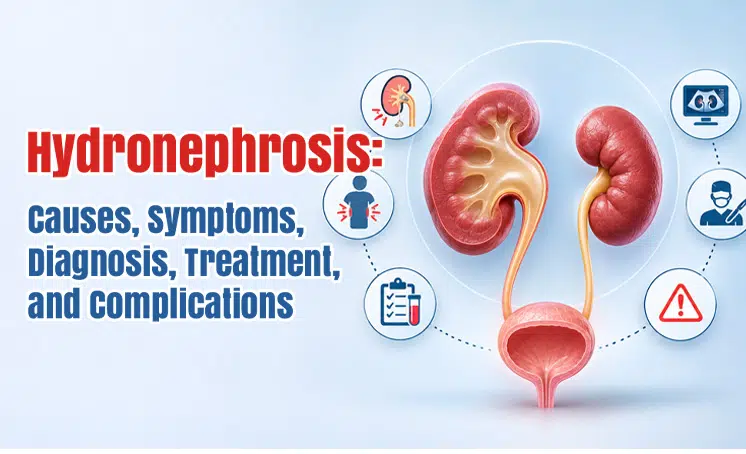
You saw “hydronephrosis” on an ultrasound report, or a doctor said your kidney looks swollen. Or side pain sent you searching. Now you’re asking: is it serious, what caused it, and will it need surgery?
Here’s the short answer. Hydronephrosis is a swollen kidney caused by urine that can’t drain. It turns serious only if the blockage lasts. A stone, an enlarged prostate or a birth difference is often behind it, and doctors treat that cause. Surgery isn’t always needed, but fever with pain is an emergency.
At PSRI Hospital, Sheikh Sarai, New Delhi, our Urology team is one of our centres of excellence. NABH and NABL accredit us, and we’ve cared for patients since 1996. This guide about Hydronephrosis: causes, hydronephrosis symptoms follows your questions in order: causes, symptoms, tests, treatment, kidney damage and warning signs.
What Is Hydronephrosis, and Is It Serious?
Hydronephrosis is a swollen kidney, and it turns serious only if the blockage lasts. It can affect one or both kidneys. Urine backs up, the kidney stretches, and that pressure can harm it over time. A short or partial blockage can stay mild and silent.
Your kidneys filter blood and make urine. Urine then travels down two tubes, called ureters, to the bladder. A blockage anywhere along that route can back it up.
What Causes Hydronephrosis in Adults and Babies?
The main hydronephrosis causes are a blockage that stops urine leaving the kidney and reflux, where urine flows backward. Medical News Today lists these triggers:
| Group | Common Causes |
|---|---|
| Adults | Kidney stones, enlarged prostate, pregnancy, certain cancers, narrowed tubes after injury or infection, nerve damage around the bladder |
| Babies | A part of the urinary system that formed differently before birth |
Reflux, which doctors call vesicoureteral reflux, means the valve between the bladder and the ureter doesn’t close properly.
Knowing the hydronephrosis causes shapes the treatment. A stone can jam inside a ureter. An enlarged prostate can squeeze the urethra, the tube that carries urine out of the bladder. In pregnancy, the growing womb can press on the ureters.
Stones are a common trigger. A 2017 AIIMS study in Ballabgarh, northern India, found that 7.9% of people surveyed had had a urinary stone.

What Are the Hydronephrosis Symptoms?
Many people have no hydronephrosis symptoms, and doctors often find it on a scan done for another reason. When symptoms appear, they include pain in the side, back or belly. Some people pass urine less often, see blood in it, or have nausea, vomiting or fever. A urinary tract infection (UTI), an infection anywhere in the urine passage, can also show up.
A slow blockage often stays silent. A sudden one, such as a stuck stone, tends to cause pain. See a doctor within a few days for side pain that keeps returning, blood in your urine or repeated UTIs.
Babies often show nothing. Repeated UTIs, sometimes with only an unexplained fever, poor feeding or low energy, can be clues.
How Is Hydronephrosis Diagnosed?
Doctors diagnose hydronephrosis with an ultrasound scan, which uses sound waves to show a swollen kidney. It’s painless. Your doctor first asks about pain, urine changes, past stones, your prostate or pregnancy, then examines your belly and sides.
A hydronephrosis diagnosis isn’t complete until the cause is known, so doctors add tests. Bring old scans and reports to the visit.
- Urine and Blood Tests: They check for infection or blood.
- CT Scan: It gives a 3D picture of the urinary system.
- Nuclear Scan: It tracks how urine moves through the body.
- Voiding Cystourethrogram: This X-ray, taken with dye in the bladder, shows reflux or a blockage.
How Is Hydronephrosis Treated?
Hydronephrosis treatment depends on the cause, how severe the swelling is and your symptoms. The first goal is to let urine drain. The next is to fix whatever blocks it.
- Draining Urine: In severe cases, doctors pass a catheter, a thin tube, through the urethra into the bladder. Or they place a nephrostomy tube, which goes through the back into the kidney.
- Medicines: Pain relief eases symptoms, and antibiotics treat or prevent UTIs. Don’t start antibiotics on your own.
- Surgery: It removes a blockage or fixes reflux, and it may be minimally invasive. Pyeloplasty is surgery that removes a blocked section and reconnects the ends.
- Stone Treatment: Larger kidney stones may need laser treatment or minimally invasive removal.
Your urologist, a doctor who treats the urinary system, chooses what suits your cause. Mild swelling may only need repeat scans. Your doctor may also repeat the scan after treatment to confirm that urine drains well.
Can Hydronephrosis Damage Your Kidneys?
Yes, if the blockage stays. Medical News Today says untreated hydronephrosis can cause permanent kidney damage or kidney failure. If both kidneys fail, a person needs dialysis, a machine that cleans the blood, or a kidney transplant.
A blocked kidney can also collect infected urine, which is why fever matters. A timely hydronephrosis diagnosis lets doctors act before the kidney suffers. That’s the risk of waiting. It isn’t the usual result of a timely check. Your urologist decides whether to treat now or keep watching.

When Is Hydronephrosis an Emergency?
It’s an emergency when a blocked kidney comes with fever or severe pain, or when you can’t pass urine. Repeated vomiting counts too. These signs can mean infection or a fast rising blockage.
Don’t wait for the morning. If you need a 24 hours emergency hospital near me, call +91 84 84 84 84 17. Or go to the nearest emergency department. Our 24×7 emergency service takes these calls day and night.
Book Hydronephrosis Treatment in Delhi at PSRI Hospital
Look for a team that can drain a blocked kidney quickly and treat the cause under one roof. You may be searching for the best hospital in Delhi or the best hospital in New Delhi. A ranking doesn’t tell you what matters, so ask each hospital directly:
- Are urologists available, and is emergency care open all night?
- Are CT and MRI scans on site?
- Is dialysis available if the kidney is damaged?
- Can the team treat stones and prostate problems with minimally invasive methods
Many people only search for a 24 hours emergency hospital near me once the pain starts. Check night time urology cover now.
We opened in 1996 and run over 35 specialties. Our urology department works with multislice CT and 3.0 Tesla MRI. We also run a Versius robotic system, 24×7 dialysis and a 24×7 blood bank. You’ll find us at Press Enclave Marg, Sheikh Sarai II, near Saket Court. Saket, Malviya Nagar and Hauz Khas are close.
Been told you have hydronephrosis, or living with side pain? Talk to our urology team about the cause and the right treatment, or ask for a second opinion first. Comparing the best hospital in Delhi or the best hospital in New Delhi options? Judge us on the questions above. Knowing the cause is the first step to protecting your kidney, and we’re here in Sheikh Sarai, New Delhi.
Call +91 84 84 84 84 17 to book an appointment at PSRI Hospital.
Frequently Asked Questions
Can Hydronephrosis Go Away on Its Own?
Sometimes. Medical News Today says pregnancy related cases usually resolve after the pregnancy ends, and many babies’ cases settle without treatment. Adults with a blockage usually need the cause treated.
Can Hydronephrosis Affect Only One Kidney?
Yes. It can affect one or both kidneys, so doctors scan both.
Can I Drink More Water to Treat Hydronephrosis?
Water can’t remove a stuck stone or another physical blockage. Ask your doctor how much to drink, since advice depends on the cause.
Which Doctor Treats Hydronephrosis?
A urologist treats it. A nephrologist, a kidney specialist, may join in if your kidney function drops.
What Is the Difference Between Hydronephrosis and Kidney Stones?
A stone is a hard deposit that forms in the urinary tract. Hydronephrosis is the swelling a stuck stone can cause.
Is Blood in the Urine Always Hydronephrosis?
No. Blood in the urine has many causes, such as infection or stones. It needs a check either way.
Can Hydronephrosis Come Back?
It can, if the cause returns. New stones are one example. Follow your doctor’s follow up plan.