Book An Appointment
 Virtual Consultation
World Heart Day 2026: Risks, Awareness and Prevention

FACT CHECKED
Your father says the chest pain is just gas. He’s been saying that for two weeks. Your mother says he’s always been like this, never one to go to the doctor. You tell yourself it’s probably nothing.
That delay is exactly what World Heart Day 2026 exists to address. It’s not unusual. It’s the norm.
India accounts for one-fifth of global cardiovascular disease deaths, according to a 2025 systematic review published in the International Journal of Environmental Research and Public Health. Most of those deaths hit people under 70. CVDs claimed 20.5 million lives globally in 2021 alone, according to the same review. The numbers aren’t slowing down. They’re getting worse.
World Heart Day 2026 falls on Tuesday, 29 September. This blog covers the World Heart Day 2026: Risks, the warning signs people explain away, and the prevention steps that actually have evidence behind them.
Dr. K K Talwar, Chairman of Cardiac Sciences at PSRI Hospital, New Delhi, leads a team that evaluates and treats the full range of heart conditions, from chest pain and arrhythmia to heart failure, bypass surgery and valve disease.
What Is World Heart Day 2026 and Why Does It Matter?
World Heart Day awareness began in 2000 when the World Heart Federation (WHF) launched it as a global campaign to reduce cardiovascular disease and stroke. The World Heart Federation runs its 2024 to 2026 campaign under the theme “Use Heart for Action,” encouraging individuals, communities and governments to take cardiovascular health seriously. World Heart Day 2026 falls on Tuesday, 29 September.
According to the World Health Organization, nearly 18 million people die each year from heart-related issues. About 85% of those deaths are due to heart attack and stroke.
For Indian families, the day isn’t just a global observance. It’s a reason to act. CVDs accounted for 27% of all deaths in India in 2016, and the burden continues to rise. The problem isn’t just that heart disease kills. It’s that most people don’t act until it becomes an emergency.
How Big Is the Heart Disease Problem in India?
The numbers are specific and they matter.
India accounts for one-fifth of global CVD-related deaths, especially among the younger population. A 2025 systematic review covering studies from 2000 to 2024 found the pooled prevalence of CVD among Indian adults at 11%, with urban areas showing a higher rate of 12% compared to 6% in rural areas.
That urban figure matters for Delhi. A working adult in their 40s sitting at a desk for ten hours a day, eating at irregular times, managing work stress and breathing Delhi’s air carries a measurably different cardiac risk than the national average suggests.
Three patterns make India’s cardiac problem distinct from global trends:
- Earlier Onset: Indian patients develop coronary artery disease a decade earlier than their Western counterparts on average
- Silent Presentation: Many Indians with high blood pressure or early coronary disease have no symptoms until a cardiac event occurs
- Delayed Diagnosis: The gap between first symptoms and first cardiology consultation runs to months or years in most cases, not days
World Heart Day prevention starts with understanding that this isn’t a disease that announces itself. Most of the time, it doesn’t. Most of the time, it doesn’t.
What Are the Warning Signs of Heart Disease?
Knowing what to look for changes the outcome. The cardiovascular disease symptoms most people miss aren’t always dramatic.
Warning Signs of a Heart Attack:
- Chest pain, pressure, squeezing or tightness, often in the centre or left side
- Pain spreading to the left arm, jaw, neck or back
- Sudden breathlessness with or without chest pain
- Cold sweating without fever or exertion
- Nausea or vomiting with chest discomfort
- Feeling of dread or something being seriously wrong
- Dizziness or light-headedness with chest symptoms
Warning Signs of Heart Failure:
- Swelling in the feet, ankles or legs that worsens through the day
- Breathlessness when lying flat or during mild activity
- Waking at night unable to breathe
- Rapid weight gain from fluid retention
- Persistent fatigue with minimal effort
Warning Signs of Arrhythmia:
- Palpitations: a fluttering, racing or pounding sensation in the chest
- Episodes of dizziness or near-fainting
- Sudden weakness without exertion
One critical rule: any chest symptom accompanied by sweating, breathlessness or arm pain needs emergency care, not an antacid.
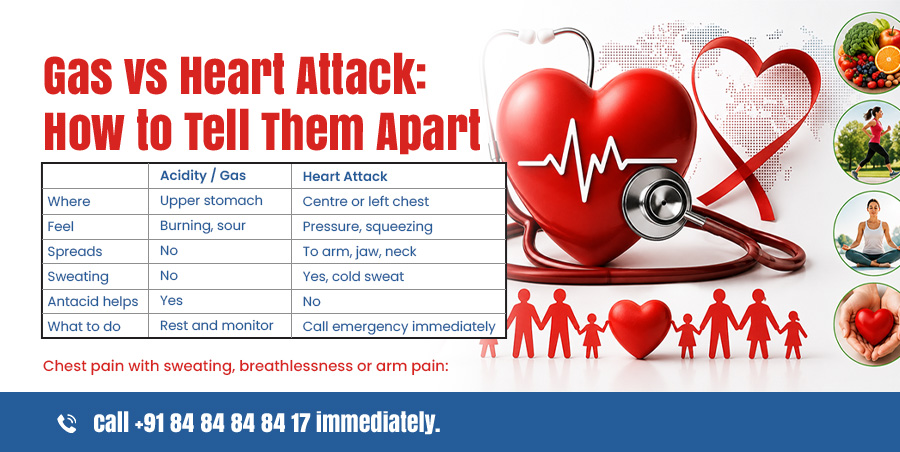
Is It Just Gas or Is It Your Heart?
This is the question most people in India get wrong, and it costs lives. Acidity and heart attack share enough surface symptoms that patients routinely wait hours or days before seeking help.
Here is how to tell them apart:
| Symptom | Acidity or Gas | Heart Attack |
|---|---|---|
| Location | Upper stomach, below chest | Centre or left chest, may spread |
| Feeling | Burning, bloating, sour taste | Pressure, squeezing, tightness |
| Triggers | After eating, spicy food, lying down | At rest, during exertion or stress |
| Sweating | Not typically | Yes, cold sweating is a key sign |
| Breathlessness | Not typically | Common, especially with exertion |
| Arm or jaw pain | Not typical | Yes, spreads to left arm or jaw |
| Antacid response | Usually improves | Does not improve |
| Duration | Comes and goes, eases with time | Persistent, may worsen |
The rule that saves lives: If chest discomfort comes with cold sweating, breathlessness or pain radiating to the arm or jaw, treat it as cardiac until proven otherwise. Don’t wait for an antacid to work.
What Are the Risk Factors for Heart Disease?
Understanding your risk tells you which prevention step matters most for you specifically.
Non-Modifiable Risk Factors (cannot be changed):
- Age: Risk rises significantly after 45 in men and after menopause in women
- Gender: Men face higher cardiac risk earlier. Women’s risk rises sharply after menopause
- Family History: A first-degree relative with heart disease before 55 in men or 65 in women raises your risk substantially
- Genetics: Some people inherit a tendency toward high cholesterol or high BP regardless of lifestyle
Modifiable Risk Factors (can be changed or controlled):
- High blood pressure: the single most common modifiable cardiac risk factor in India
- High LDL cholesterol and low HDL cholesterol
- Poorly controlled diabetes
- Smoking and tobacco use in any form
- Obesity, especially central obesity (belly fat)
- Physical inactivity
- Chronic stress and poor sleep
- Excessive alcohol consumption
- Air pollution exposure, particularly relevant for Delhi residents
The India-specific reality: urban areas in India show a CVD prevalence of 12%, compared to 6% in rural areas, driven largely by the modifiable risk cluster of sedentary work, stress, irregular meals and high BP that defines urban professional life.
What Are the Best Heart Disease Prevention Steps?
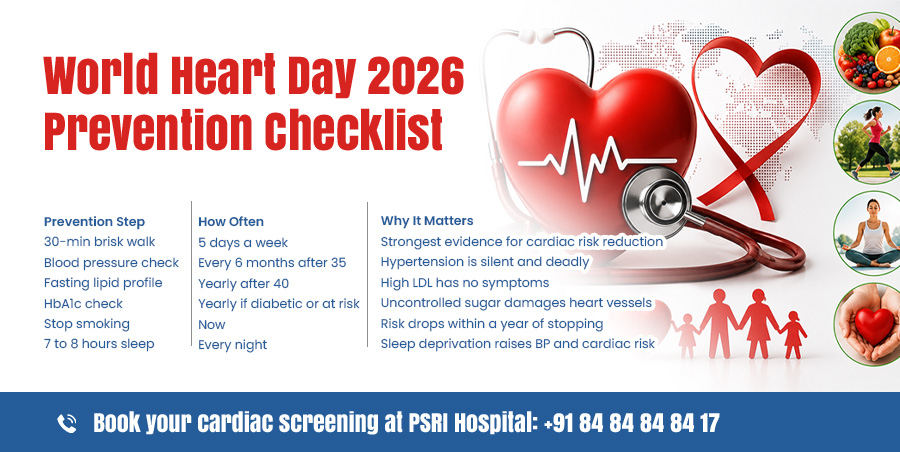
World Heart Day prevention isn’t about doing one big thing. It’s about reducing your modifiable risk consistently over time.
What the Evidence Supports:
- Regular Physical Activity: 150 minutes of moderate aerobic activity per week, spread across five days, cuts cardiac risk meaningfully. A 30-minute walk five days a week qualifies. You don’t need a gym.
- Blood Pressure Control: Hypertension is the leading modifiable cardiac risk factor in India. Check it every six months if you’re above 35. Control it through diet, activity and medication if your doctor prescribes it.
- Cholesterol Management: High LDL cholesterol builds plaques in arteries silently. A fasting lipid profile once a year after 40 gives you the picture you need.
- No Tobacco: Smokers face double the cardiac risk of non-smokers. The risk starts to drop within a year of stopping.
- Diabetes Management: Poorly controlled blood sugar damages the blood vessels that supply the heart. Keep HbA1c within your doctor’s recommended range.
- Diet: The DASH and Mediterranean diets both reduce cardiac risk in large studies. Both emphasise vegetables, whole grains, legumes, fish and less salt and processed food. Less fried food, less sodium, more fibre.
- Stress and Sleep: Chronic stress raises BP and cortisol, both of which damage the heart over time. Seven to eight hours of sleep supports cardiovascular recovery overnight.
- Regular Cardiac Screening: Many serious cardiac conditions show no symptoms until they become emergencies. An ECG, lipid profile and BP check take under an hour and can catch risk before it becomes a crisis.
What Doesn’t Work: Supplements, detox drinks and superfoods don’t prevent heart disease. The evidence is for sustained habits over years, not short-term fixes.
When Should You See a Heart Doctor or Cardiologist?
Not every chest symptom needs a cardiologist. But some do, and most people wait far too long to find out which category they’re in. That’s the real risk.
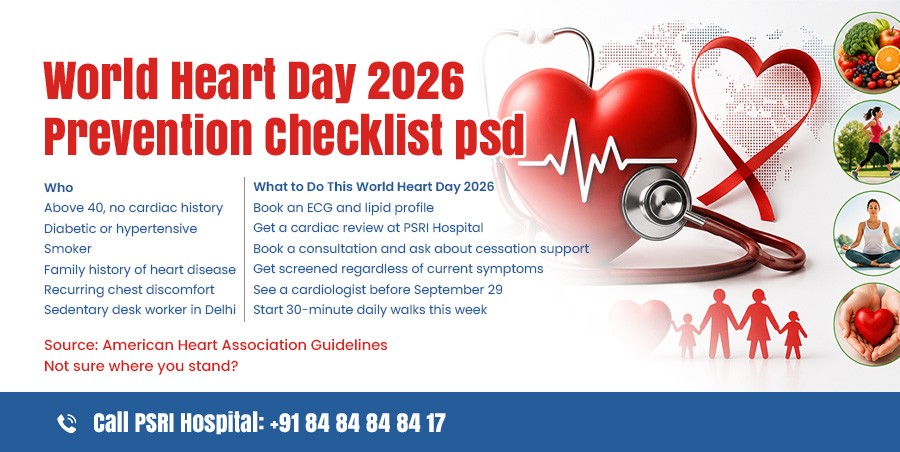
See a heart doctor near me or a cardiologist if:
- Chest pain, pressure or tightness keeps coming back without a clear cause
- You have breathlessness during activity that didn’t bother you six months ago
- Your heart races, flutters or skips beats regularly
- You’ve fainted or nearly fainted without a clear reason
- Your BP reading has been above 140/90 on more than two separate occasions
- You have diabetes and haven’t had a cardiac review in over a year
- A family member had a heart attack before 55 (men) or 65 (women)
- You’re above 40 and have never had an ECG or lipid profile
A cardiology consultation involves a clinical history, BP measurement, ECG, blood tests and an echocardiogram if needed. For the cardiac sciences department at PSRI Hospital, this evaluation gives a complete picture of current cardiac health and specific risk reduction steps.
Call for emergency care immediately if: Chest pain comes with sweating, breathlessness, arm or jaw pain, dizziness or nausea. Don’t drive yourself. Call +91 84 84 84 84 17.
Book a Cardiac Consultation at PSRI Hospital This World Heart Day 2026
World Heart Day 2026 on 29 September is the right moment to stop explaining away the signs and get a proper cardiac evaluation.
The Cardiac Sciences department at PSRI Hospital evaluates and treats chest pain, high BP, arrhythmia, heart failure, coronary artery disease, valve disease and complex cardiac surgical conditions.
Dr. K K Talwar, Chairman of Cardiac Sciences at PSRI Hospital, New Delhi, brings 47 or more years of experience in cardiology. He holds MBBS, MD in Medicine and DM in Cardiology qualifications, along with professional fellowships. The cardiac team at PSRI includes senior consultants, a cardiothoracic surgical team and a dedicated cardiac ICU.
For patients looking for the best heart surgeon in Delhi or a heart specialist near me, PSRI Hospital offers specialist-led evaluation, advanced diagnostics and full cardiac surgical capability under one roof.
Why Families Across Delhi NCR Choose PSRI Hospital for Cardiac Care:
- Cardiologists, interventional specialists and cardiothoracic surgeons together
- Cath lab, ECG, Echo, TMT, angiography and angioplasty services
- Dedicated Cardiac ICU and 24×7 emergency cardiac support
- The best heart surgeon in Delhi NCR for bypass surgery, valve surgery and complex cardiac procedures
- NABH and NABL accredited multispeciality hospital near Saket Court, Sheikh Sarai II, New Delhi
- Accessible from Malviya Nagar, Panchsheel Park, Hauz Khas, Greater Kailash and South Delhi
If you’ve been explaining away chest pain, breathlessness or palpitations, don’t wait for the next episode to be more serious.
For a heart doctor near me in South Delhi or for 24/7 cardiac emergencies, call +91 84 84 84 84 17 to book your cardiac consultation at PSRI Hospital.
For preventive cardiac check-ups and heart health screening, read about preventive health check-ups at PSRI Hospital. For stroke awareness and related neurological cardiac risks, read the PSRI guide on stroke warning signs.
Frequently Asked Questions
When is World Heart Day 2026?
World Heart Day 2026 falls on Tuesday, 29 September 2026. It’s observed every year on 29 September by the World Heart Federation and recognised globally by the World Health Organization.
What is the World Heart Day 2026 theme?
The World Heart Federation runs its 2024 to 2026 campaign under the theme “Use Heart for Action,” encouraging individuals, communities and governments to take meaningful action on cardiovascular health, not just raise awareness.
What are the early warning signs of a heart attack?
Chest pressure or tightness, pain spreading to the left arm or jaw, cold sweating, breathlessness and nausea are the key signs. Any chest symptom with sweating or breathlessness needs emergency care immediately, not home management.
Can heart disease be prevented?
Most heart disease risk is modifiable. That’s the single most important fact about cardiac prevention. Regular physical activity, blood pressure control, no smoking, managing cholesterol and diabetes, and eating well reduce cardiac risk substantially. Regular screening catches silent risk before it becomes a crisis.
At what age should someone see a cardiologist for the first time?
Anyone above 40 with no cardiac history should have an ECG and lipid profile. It’s an hour of your time. It’s not a reason to delay. Anyone with diabetes, hypertension, a smoking history or a family history of heart disease should see a cardiologist regardless of age or current symptoms.