Book An Appointment
 Virtual Consultation
Mitral Valve Regurgitation: Causes, Symptoms & Treatment

FACT CHECKED
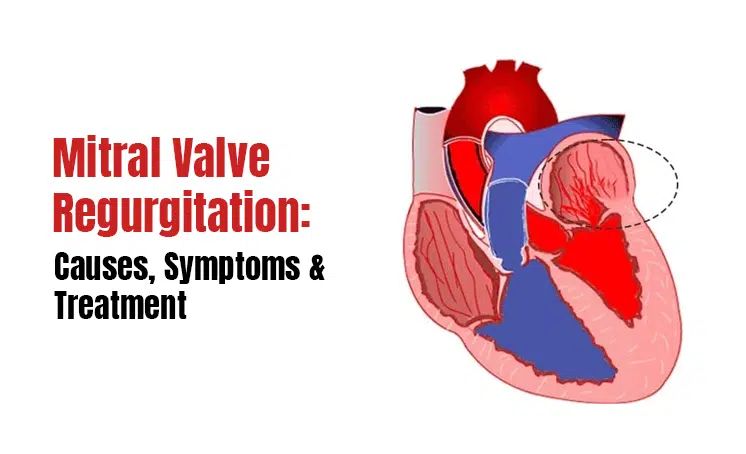
An echo report says “leaky valve,” and suddenly stairs feel harder to climb. Mitral valve regurgitation means a valve in the heart doesn’t close all the way. So a little blood slips backward with each heartbeat instead of moving forward.
It’s caused by either direct valve damage, past rheumatic fever, or by a separate heart condition that stretches the valve out of shape.
Dr K K Talwar, Chairman of Cardiac Sciences at PSRI Hospital in South Delhi, has been grading cases like this for more than 47 years. And that grading actually decides whether someone needs to see a cardiologist urgently or just come back next year for a check.
What Is Mitral Valve Regurgitation?
The heart has four valves. Each one opens to let blood pass, then closes to stop it moving backward. Mitral valve regurgitation is a leak in the mitral valve, one of the heart’s four valves, sitting between the upper and lower chambers on the left side.
The valve should close tightly with every heartbeat. When it doesn’t, some blood moves backward instead of forward, and the heart works harder to compensate.
Primary Vs Secondary Mitral Regurgitation
Cardiologists split MR into two types depending on where the problem starts.
- Primary MR means something has damaged the valve tissue itself, the leaflets or the cords holding them.
- Secondary MR is when the valve looks structurally normal, but a separate heart problem, usually an enlarged left ventricle, keeps it from sealing shut.
This distinction changes what mitral valve regurgitation treatment can fix.
What Causes Mitral Valve Regurgitation?
Mitral valve regurgitation comes from one of two places: damage to the valve tissue itself, or a separate heart condition that stretches the valve out of shape.
According to a review in the Indian Journal of Cardiovascular Disease in Women, rheumatic fever accounts for 25 to 45 percent of acquired heart disease cases in the country, a share that’s far higher than in the West.
Valve-Related Causes
A problem with the valve or its cords can come from:
- Mitral valve prolapse, when a valve flap bulges backward
- Rheumatic fever, an illness that can damage the valve
- A birth defect in the valve, present from birth
- Simple wear and tear on the valve as a person ages
- Endocarditis, an infection that attacks the valve directly
Mitral Valve Regurgitation Causes Outside The Valve
Sometimes the valve itself is fine, but another heart problem stops it from closing right:
- A past heart attack, which can scar the muscle that holds the valve in place
- Cardiomyopathy, a disease that makes the heart muscle weak
- Long-term high blood pressure, which can stretch the heart’s lower left chamber
What Are The Symptoms Of Mitral Valve Regurgitation?
Mild mitral valve regurgitation usually causes no symptoms. Many patients find out only from a routine murmur or an echocardiogram done at a multispeciality hospital near me. Symptoms tend to show up gradually once the leak becomes more significant.
Mitral Valve Regurgitation Symptoms
As the leak progresses, patients often notice:
- Breathlessness on stairs or during a brisk walk
- Tiredness that doesn’t match their actual activity level
- A racing heartbeat
- A dry cough that gets worse
- Mild swelling around the feet
Is Breathlessness Or Fatigue Always A Reason To See A Cardiologist?
No, not always. If an echocardiogram at the best hospital in Delhi shows mild regurgitation and normal chamber size, most cardiologists simply recheck the patient every year or so. There’s no need to jump to treatment before that.
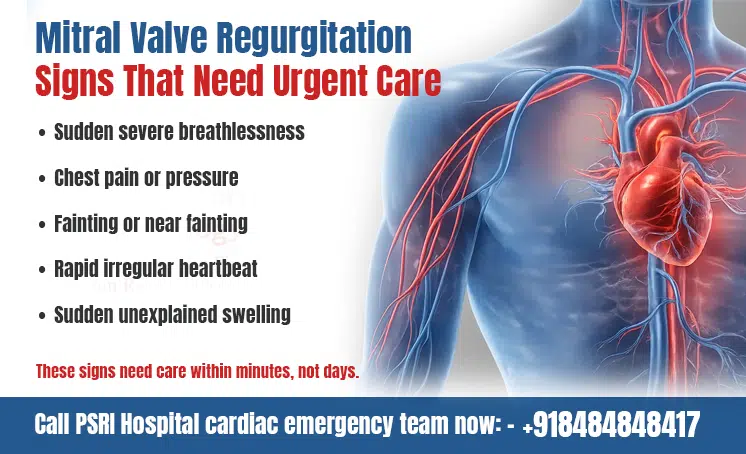
Visit a cardiologist right away if you notice:
- Breathlessness that keeps getting worse, month after month
- Waking up gasping for air
- A heart that still beats fast or unevenly, even at rest
These changes usually mean the leak has progressed and the heart is working harder to keep up. That’s when a 24 hours emergency hospital near me becomes the right call.
Where Can You Get Mitral Valve Regurgitation Treatment In Delhi?
PSRI Hospital, one of the best hospital in New Delhi has a cardiac sciences department which evaluates and treats mitral valve regurgitation starting with an echocardiogram to grade the leak. The final treatment then depends on that grade.
Treatment Approach by Severity
| Approach | When it’s used |
|---|---|
| Monitoring only | Mild MR with normal-sized heart chambers |
| Medication | Managing symptoms or a related condition like high blood pressure |
| Valve repair or replacement | Significant leak or symptoms affecting daily life |
PSRI, a multispeciality hospital in Delhi, backed by NABH and NABL accreditation has a CTVS team who handles repair and replacement surgery on the same campus as cardiology and critical care, so a patient isn’t referred elsewhere.
If stairs leave someone breathless, or an echo report mentions a leaky valve, it’s worth finding out what that means before it gets worse. Call +91 84 84 84 84 17 to book a consultation with PSRI Hospital.
Frequently Asked Questions
Can mitral valve regurgitation heal on its own?
No. A leaky valve doesn’t fix itself. Some mild cases stay the same for years without any treatment. But the leak only goes away with medicine or surgery.
Can mitral valve regurgitation be treated without surgery?
Yes, in many mild or medium cases. Doctors often use medicine and regular checkups instead. Surgery usually only happens if the leak gets bad or affects daily life.
How serious is moderate mitral valve regurgitation?
Moderate cases are not usually an emergency. But they can slowly get worse over time. That’s why doctors repeat heart scans often, so they can catch any change early.
Can mitral valve regurgitation cause sudden death?
Yes, but only in rare, severe cases. A bad leak left untreated can cause heart failure or a sudden heart stop. Worse symptoms need quick checking.