Book An Appointment
 Virtual Consultation
World Alzheimer’s Day 2026: Awareness and Prevention

FACT CHECKED
Your father misplaced his keys again. Then forgot what he went to the kitchen for. Then couldn’t recall a name he’s known for thirty years.
You told yourself it’s just age. Most families do.
Every September, World Alzheimer’s Day 2026 draws attention to a disease most Indian families are already living with and not talking about. According to the Fogarty International Center and the Longitudinal Ageing Study in India, 8.8% of Indians above 60 live with dementia. That’s around 5.5 million people. Alzheimer’s disease causes 70 to 75% of those cases.
Dr. Nitin Kumar Sethi chairs the Neurosciences at PSRI Hospital, the best hospital in Delhi. His team evaluates memory concerns, cognitive changes and neurological symptoms across all age groups.
Read this blog to know all about World Alzheimer’s Day 2026: World Alzheimer’s Day Awareness and Alzheimer’s Prevention.
What Is World Alzheimer’s Day 2026 and Why Does It Matter?
Most Indian families notice memory changes in a parent or grandparent long before anyone sees a doctor. World Alzheimer’s Day 2026 exists to close that gap. It falls on Sunday, 21 September. Alzheimer’s Disease International (ADI) launched it in Edinburgh in 1994, and the World Health Organization recognises it as the annual focal point for global dementia awareness.
More than 55 million people worldwide live with Alzheimer’s and other forms of dementia. World Alzheimer’s Month runs throughout September, with 21 September as the centrepiece.
The 2026 campaign theme focuses on Alzheimer’s diagnosis: why it matters, what it gives families access to and why most people wait too long before pursuing one. ADI releases the annual World Alzheimer’s Report on 21 September each year. The 2026 report adds new data on early detection and diagnosis rates globally.
In India, the gap between noticing the first memory change and receiving a diagnosis runs to several years on average. World Alzheimer’s Day awareness campaigns exist to shorten that gap. For neurosciences and memory care at PSRI Hospital, early referral makes a direct difference to what treatment options remain available.
What Is Alzheimer’s Disease?
Alzheimer’s disease is a progressive brain disorder that destroys memory first, then reasoning, language and the ability to carry out everyday tasks. It develops slowly, often over years, and that’s exactly why families keep explaining away the early signs.
Alzheimer’s disease causes between 70 and 75% of all dementia cases. Dementia isn’t one disease. It’s an umbrella term for a group of symptoms that affect memory, thinking and daily function. Alzheimer’s is the most common cause.
There’s no complete cure for Alzheimer’s disease. That’s an honest statement every awareness piece should make. But early diagnosis still matters enormously. It gives patients access to treatment that can slow the rate of decline. It lets families plan care, make legal and financial decisions while cognition still allows it, and explore clinical trials for emerging therapies. Waiting removes those options one by one.
Is It Just Forgetfulness or Something More?
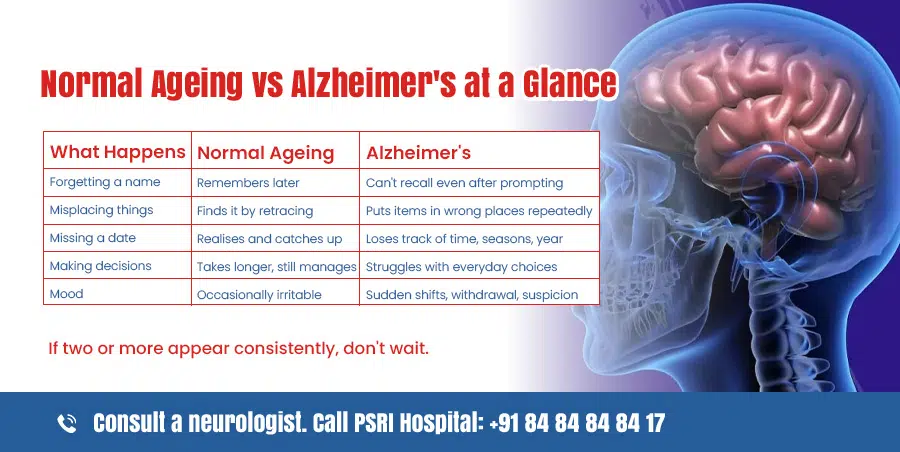
Normal ageing does affect memory. But Alzheimer’s isn’t normal ageing. The warning signs look and feel different from ordinary forgetfulness. Here is how to tell them apart:
| Situation | Normal Ageing | Alzheimer’s Warning Sign |
|---|---|---|
| Forgetting a name | Remembers it later | Can’t recall it even after prompting |
| Misplacing things | Retraces steps and finds it | Puts objects in wrong places repeatedly |
| Missing a date | Realises later and remembers | Loses track of dates, seasons, time passing |
| Making a decision | Takes longer but manages | Struggles with everyday decisions |
| Conversation | Occasionally searches for a word | Stops mid-sentence, repeats the same story |
| Completing tasks | Takes more effort than before | Can’t finish familiar tasks at home or work |
| Mood changes | Occasionally irritable | Sudden personality shifts, anxiety or withdrawal |
If more than one happens consistently, that’s not a normal ageing pattern. That’s a reason to see a neurologist.
What Are the Early Warning Signs of Alzheimer’s Disease?
The Alzheimer’s Association identifies ten warning signs across global clinical practice. These build gradually, not all at once:
- Memory Loss That Disrupts Daily Life: Forgetting recently learned information, important dates or asking the same question repeatedly
- Difficulty Planning or Solving Problems: Trouble following a recipe, managing a monthly budget or tracking bills
- Difficulty Completing Familiar Tasks: Getting lost on a drive they’ve made hundreds of times, or forgetting the rules of a game they play regularly
- Confusion With Time or Place: Losing track of the day, the season or where they are
- Trouble Understanding Visual Images: Difficulty reading, judging distance or distinguishing colours
- New Problems With Words: Stopping mid-sentence, struggling to join a conversation, calling things by the wrong name
- Misplacing Things and Losing the Ability to Retrace Steps: Putting items in unusual places and accusing others of theft
- Decreased or Poor Judgement: Making large financial decisions impulsively or ignoring personal hygiene
- Withdrawal From Social Activities: Avoiding work, hobbies, social events or family gatherings they previously enjoyed
- Changes in Mood and Personality: Becoming confused, suspicious, depressed, fearful or anxious, especially outside familiar settings
Occasional forgetfulness isn’t on this list. Persistent, progressive changes across multiple areas are.
Who Is at Risk of Developing Alzheimer’s?
Age remains the biggest risk factor. Most people with Alzheimer’s are 65 or older. But the disease doesn’t only affect the elderly. Early-onset Alzheimer’s affects people in their 40s and 50s, though it’s far less common.
Family History and Genetics raise risk. A first-degree relative with Alzheimer’s increases a person’s likelihood. Specific gene variants, particularly APOE-e4, raise risk further, but carrying the gene doesn’t guarantee the disease.
Modifiable Lifestyle Risk Factors include:
- High blood pressure, particularly in midlife
- Poorly managed diabetes
- High cholesterol
- Obesity
- Smoking
- Excessive alcohol
- Physical inactivity
- Social isolation
- Chronic poor sleep
- Untreated depression
In India, rising rates of hypertension and diabetes in urban populations make these modifiable risk factors increasingly urgent. People in their 40s and 50s may be decades away from Alzheimer’s symptoms but actively building risk today.
What Steps Actually Help in Alzheimer’s Prevention?
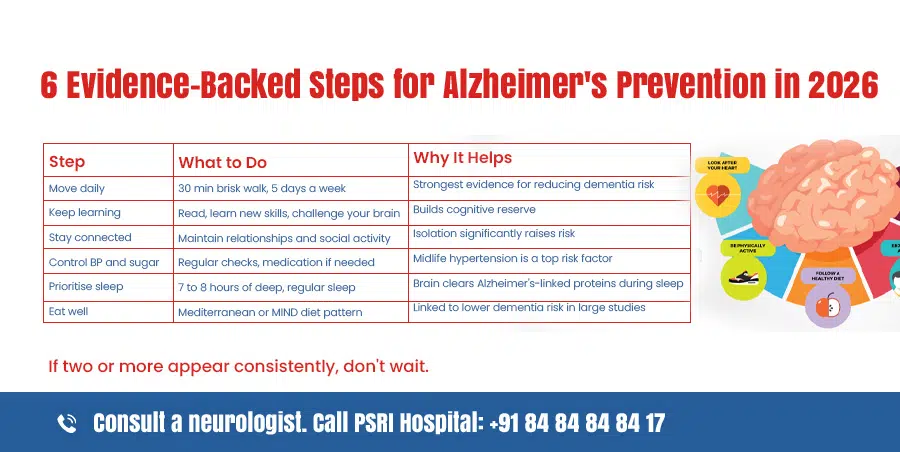
No intervention can guarantee Alzheimer’s won’t develop. But strong evidence supports that certain lifestyle habits reduce the risk of cognitive decline. They may also delay onset in people who carry risk factors.
What the Evidence Supports:
- Regular Physical Activity: 30 minutes of brisk walking five days a week has the strongest evidence for reducing dementia risk
- Mental Engagement: Reading, learning new skills and staying intellectually active builds cognitive reserve, the brain’s ability to adapt and compensate
- Social Connection: Chronic isolation raises dementia risk significantly. Relationships and community involvement actively protect the brain
- Managing Blood Pressure and Blood Sugar: Midlife hypertension is one of the most consistently identified modifiable risk factors. Control it through medication and lifestyle.
- Prioritising Sleep: The brain clears amyloid beta, a protein linked to Alzheimer’s plaques, during deep sleep. Chronic poor sleep raises long-term risk
- Diet: The Mediterranean and MIND diets link to lower dementia risk in large studies. Both emphasise vegetables, fish, whole grains and less processed food
What the Evidence Does Not Yet Support: No supplement, brain-training app or single food can prevent Alzheimer’s. The evidence is for sustained lifestyle patterns over years, not short-term fixes.
When Should You See a Neurologist for Memory Concerns?
Not every memory complaint needs a neurology appointment. But some do, and families tend to underestimate which ones qualify.
See a neurologist if:
- Memory problems have gotten worse over six months, not stayed the same
- The person gets lost in familiar places or loses track of what year or season it is
- They struggle to manage tasks they’ve handled independently for years
- Personality or mood has shifted noticeably and there’s no other clear cause
- More than two or three warning signs from the list above appear together
- A family member notices the changes more than the person does, which is common in early Alzheimer’s
Early diagnosis opens access to medications that can slow progression in suitable patients. It also opens the door to specialist support, caregiver planning and clinical trial eligibility. A neurologist takes a full history, conducts cognitive tests, orders blood tests to rule out reversible causes of memory loss and recommends brain imaging when needed. Read more about preventive health check-ups at PSRI Hospital for proactive brain health screening.
Don’t wait until the person can no longer manage daily life. That point comes much later than the window when intervention helps most. For families concerned about sudden neurological symptoms, read the PSRI guide on stroke warning signs and what to do. For memory-specific concerns, consult the neurology specialists at PSRI Hospital.
Book a Neurology Consultation at PSRI Hospital This World Alzheimer’s Day
World Alzheimer’s Day 2026 on 21 September is the right moment to stop explaining away the signs and get a proper evaluation.
The PSRI Institute of Neurosciences at PSRI Hospital, New Delhi, evaluates memory concerns, cognitive changes, early-stage dementia symptoms and complex neurological conditions. Dr. Nitin Kumar Sethi, Chairman of the PSRI Institute of Neurosciences, brings 27 or more years of experience in neurology and clinical neurophysiology. He holds MBBS, DNB and FAAN qualifications.
The neurosciences team at PSRI evaluates patients through clinical examination, cognitive assessment, blood tests and neuroimaging where needed, and guides families on next steps without alarm or delay.
Why Families Across Delhi NCR Choose PSRI Hospital for Neurology Care:
- Senior neurology and neurosurgery specialists under one roof
- Dedicated Neuro ICU, neuro navigation, video EEG and MRI support
- NABH and NABL accredited multispeciality hospital in Delhi, trusted since 1996
- Near Saket Court, Sheikh Sarai II, accessible from Malviya Nagar, Panchsheel Park, Hauz Khas and South Delhi
- The best hospital in New Delhi for comprehensive specialist neurology care
Whether you need a first evaluation, a second opinion or ongoing neurology support, PSRI Hospital, the best multispeciality hospital near me in Saket, offers coordinated, specialist-led care across all neurological conditions.
For the 24 hours emergency hospital near me, call +91 84 84 84 84 17. To book a neurology appointment at PSRI Hospital, one of the best hospital in Delhi.
Frequently Asked Questions
What day is World Alzheimer’s Day 2026?
World Alzheimer’s Day 2026 falls on Sunday, 21 September. It forms the centrepiece of World Alzheimer’s Month, which runs throughout September each year.
What is the difference between dementia and Alzheimer’s disease?
Dementia is an umbrella term for a group of symptoms affecting memory, thinking and daily function. Alzheimer’s disease is the most common cause of dementia, responsible for 70 to 75% of cases worldwide.
Can Alzheimer’s disease be prevented?
No intervention guarantees prevention. But regular physical activity, managing blood pressure and blood sugar, staying socially and mentally active and prioritising sleep reduce the risk of cognitive decline significantly over time.
At what age should someone see a neurologist for memory concerns?
There’s no minimum age. If memory changes worsen over months, affect daily function or come with personality shifts, see a neurologist regardless of age. Earlier evaluation gives more options.
What tests help diagnose Alzheimer’s disease?
Diagnosis typically involves a clinical history, cognitive tests, blood tests to rule out reversible causes and brain imaging such as MRI or CT scan. A neurologist interprets the results in context. It’s not one test that confirms the diagnosis.