Book An Appointment
 Virtual Consultation
Why Should You Get a Liver Function Test Done?

FACT CHECKED
Your doctor adds an LFT to your annual checkup list. You don’t ask what it tests. You assume it’s routine. Two weeks later, the report comes back and your SGPT is elevated. You don’t know what that means. You search online and spend an hour reading contradictory answers.
That confusion isn’t necessary. A Liver Function Test tells you how well your liver is working, often well before symptoms appear. And in a country where fatty liver now affects a significant portion of urban adults and hepatitis B and C remain widespread, it’s one of the most important routine tests most people skip or misunderstand.
Dr. J C Vij, Chairman of Gastroenterology and Hepatology at PSRI Hospital, New Delhi, brings 56 or more years of experience evaluating liver disease. The gastroenterology and hepatology team at PSRI Hospital diagnoses and manages the full range of liver conditions, from fatty liver and hepatitis to cirrhosis and advanced liver disease requiring transplant evaluation.
What Is a Liver Function Test?
A Liver Function Test, or LFT test, isn’t a single blood test. It’s a panel of several blood tests run together on one sample. They’re not separate visits. Each test in the panel measures a different aspect of how the liver is working.
The liver performs over 500 functions in the body every day. It filters toxins from the blood, produces proteins needed for blood clotting, processes nutrients from food, produces bile for digestion and breaks down old red blood cells. When any part of this system breaks down, specific markers in the blood change.
An LFT test picks up those changes by measuring:
- Enzymes that leak into the blood when liver cells are damaged
- Proteins the liver produces to support body function
- Bilirubin, the waste product the liver clears from old red blood cells
- The liver’s ability to synthesise proteins that help blood clot
The result isn’t a pass or fail. It’s a picture of what the liver is doing right now, and whether anything needs further investigation.
What Does a Liver Function Test Measure?
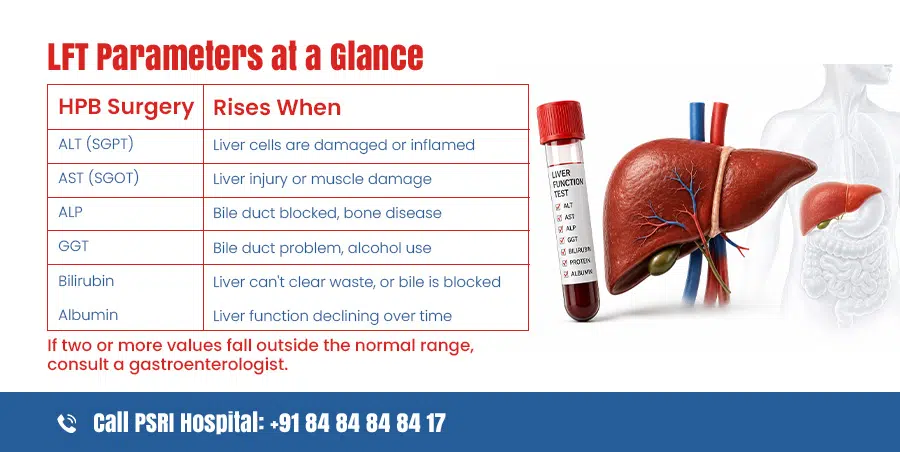
Each parameter in an LFT report measures something specific. Reading the numbers without understanding what they measure leads to unnecessary panic or false reassurance. Here’s what each one means in plain language:
| Parameter | What It Actually Measures | Normal Range |
|---|---|---|
| ALT (SGPT) | Liver cell damage. Rises when liver cells are inflamed or injured. | 7 to 56 U/L |
| AST (SGOT) | Liver and muscle damage. Rises in liver injury but also in muscle problems. | 10 to 40 U/L |
| ALP | Bile duct health and bone disease. Rises when bile flow is blocked. | 44 to 147 U/L |
| GGT | Bile duct inflammation and alcohol effect. Sensitive to alcohol intake. | 9 to 85 U/L |
| Total Bilirubin | How well the liver clears waste from old red blood cells. | 0.1 to 1.2 mg/dL |
| Albumin | Liver’s ability to produce protein. Falls when liver function declines. | 3.5 to 5.0 g/dL |
| Total Protein | Overall protein production by the liver and other sources. | 6.0 to 8.3 g/dL |
Normal ranges vary slightly between laboratories. Don’t compare your numbers to a generic online chart. Always read your result alongside the reference range on your specific lab report, not a generic online value.
Who Should Get a Liver Function Test Done?
You don’t need symptoms to get a Liver Function Test. Most serious liver conditions develop silently over years. By the time symptoms appear, significant damage may already have occurred.
Get a Liver Function Test if you have any of the following:
- Fatigue that doesn’t improve with rest
- Yellowish tinge in the eyes or skin (jaundice)
- Dark-coloured urine or pale stools
- Persistent abdominal discomfort, especially in the upper right side
- Unexplained weight loss or loss of appetite
- Nausea without an obvious cause
- Swelling in the abdomen or legs
Get a Liver Function Test if you have any of these risk factors:
- Diagnosed with fatty liver (non-alcoholic or alcoholic)
- History of hepatitis B or C exposure or infection
- Diabetes, as liver disease risk is significantly higher in diabetics
- Obesity, particularly abdominal obesity
- Regular alcohol consumption, even at moderate levels
- Family history of liver disease or liver cancer
- Taking medications known to affect the liver, including certain pain relievers, antifungals or cholesterol drugs
- Recent exposure to contaminated food or water
Get an LFT as part of routine screening if:
- You’re above 40 and haven’t had a liver check in the past year
- Your doctor includes it in your annual health check panel
- You’ve had abnormal results before and are monitoring progress
An LFT test is a simple, safe blood draw that takes under five minutes. There’s no reason to delay it. It’s one of the easiest tests you’ll have. For gastroenterology and hepatology care at PSRI Hospital, specialists evaluate LFT reports alongside symptoms, imaging and full clinical history.
What Do Abnormal LFT Results Actually Mean?
This is the section most people actually need. Getting an abnormal result doesn’t mean your liver is failing. It means something needs further investigation. The interpretation depends entirely on which values are abnormal, by how much and in what combination.
High ALT or SGPT
ALT is the most specific indicator of liver cell damage. A mildly elevated ALT, say 60 to 100 U/L, in someone with no symptoms often points to fatty liver, especially in people with diabetes or obesity. It can also rise temporarily after vigorous exercise, during viral illness or from medication effects. A significantly elevated ALT, above 300 U/L, suggests active liver inflammation from viral hepatitis, alcoholic hepatitis or drug-induced liver injury and needs urgent specialist evaluation.
High AST or SGOT
AST rises in both liver and muscle damage. An isolated AST rise without elevated ALT may reflect muscle injury rather than liver disease. When both AST and ALT rise together, liver damage is more likely.
High Bilirubin
Elevated bilirubin causes jaundice. It rises when the liver can’t process or excrete waste properly. This happens in hepatitis, cirrhosis, bile duct blockage and haemolytic conditions where red blood cells break down faster than normal.
Low Albumin
Albumin falls when the liver loses the ability to synthesise protein. Consistently low albumin is a more serious finding than elevated enzymes. It suggests long-standing or advanced liver dysfunction, including cirrhosis.
What an abnormal LFT does NOT tell you on its own:
An LFT can’t diagnose the cause of liver disease on its own. A high SGPT could mean fatty liver, hepatitis, alcohol damage or medication effect. It doesn’t tell you which one. A normal LFT cannot completely rule out liver disease. Early liver disease can show normal enzyme levels. An LFT is the starting point, not the complete answer. A gastroenterologist uses it alongside imaging, viral markers, biopsy if needed and your full clinical picture.
What Symptoms Should Make You Get an LFT Immediately?
Some symptoms shouldn’t wait for a scheduled checkup. See a doctor the same day and ask for an LFT if you notice:
- Sudden yellowing of the eyes or skin
- Dark brown or tea-coloured urine appearing without fever
- Severe abdominal pain in the upper right area
- Vomiting blood or passing black, tarry stools
- Confusion or extreme drowsiness with any liver symptoms
- Rapid unexplained weight loss alongside fatigue and loss of appetite
- Swelling of the abdomen with no clear cause
These symptoms can indicate acute hepatitis, bile duct blockage, bleeding from liver disease or early liver failure. Each needs urgent medical evaluation, not home observation.
How Do You Prepare for a Liver Function Test?
Preparation is straightforward. Getting it wrong can affect the accuracy of your results.
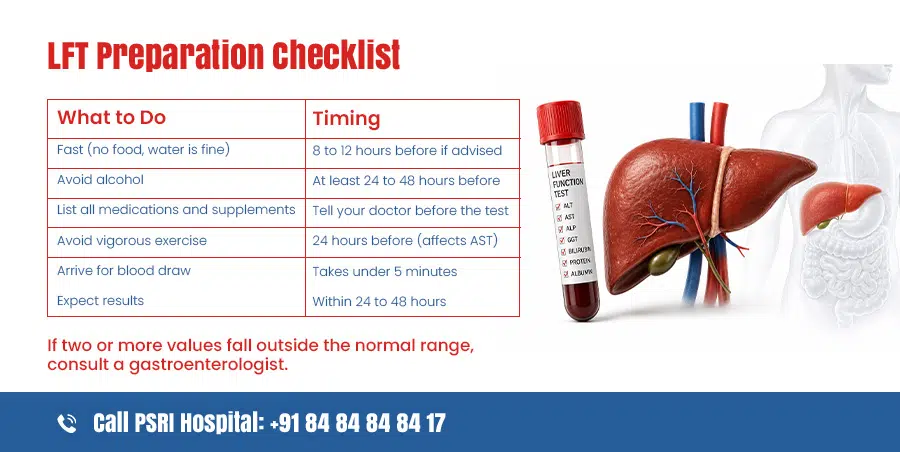
- Fasting: Fast for 8 to 12 hours before the test if your doctor advises it. Water is fine. If your LFT is part of a broader panel including cholesterol or glucose, fasting is usually required.
- Medications: Tell your doctor about every medicine, supplement or herbal remedy you take. Certain painkillers, statins, antifungals and herbal products affect liver enzyme levels and can produce misleading results.
- Alcohol: Avoid alcohol for at least 24 to 48 hours before the test. Alcohol raises GGT and can temporarily raise ALT and AST.
- The test itself: A phlebotomist draws a small blood sample from a vein in your arm. The procedure takes under five minutes. Results are typically available within 24 to 48 hours.
There’s nothing invasive about an LFT. It’s a routine blood draw. It’s a routine blood draw, identical in procedure to any other blood test.
When Should Abnormal LFT Results Lead to a Liver Specialist?
A mildly abnormal result reviewed by your GP and rechecked in six to eight weeks is often appropriate. But some patterns need a gastroenterologist or liver specialist immediately.
See a liver specialist if:
- ALT or AST is more than three times the upper limit of normal
- Both ALT and ALP are elevated together, which may suggest bile duct disease
- Bilirubin is elevated and you have visible jaundice
- Albumin is low, particularly if it has fallen progressively over time
- Your GP has found hepatitis B or C surface antigen positive on a screening test
- You have cirrhosis confirmed on ultrasound and need staging and monitoring
- Results are abnormal and you’ve had fatty liver or liver disease previously
- An ultrasound or scan shows liver changes alongside abnormal LFT values
When results move beyond fatty liver and hepatitis into cirrhosis or liver failure, specialist-led care becomes essential. And when cirrhosis progresses to end-stage liver disease, liver transplant evaluation may become the next step. For liver transplant and surgical gastroenterology care at PSRI Hospital, the team evaluates patients at all stages, from early liver disease to transplant candidacy assessment.
Book an Appointment With Expert Gastroenterologists and Hepatologists in Delhi Now
Your LFT report flagged something. Don’t sit on it.
PSRI Hospital, one of the best liver transplant centres in Delhi and a trusted liver transplant hospital in Delhi NCR since 1996, gives you specialist access from the first abnormal result to the last follow-up visit.
Dr. J C Vij, Chairman of Gastroenterology and Hepatology, brings 56 or more years of liver care expertise. Dr. Amit Rastogi leads a liver transplant team with over 1,200 procedures. Whether you need a liver function evaluation, hepatitis management, fatty liver monitoring or a full liver transplant assessment, PSRI covers it all.
Why Patients Across India Choose PSRI Hospital for Liver Care:
- One of the best liver transplant hospitals in India, with 1,200 or more successful procedures
- Expert gastroenterology, hepatology and liver transplant team under one roof
- Hospitals for liver transplant in Delhi with advanced ICU, NABH and NABL accreditation
- Located near Saket Court, Sheikh Sarai II, accessible from Malviya Nagar, Panchsheel Park and South Delhi
For questions about liver transplant cost in India or transplant eligibility, call now.
Call +91 84 84 84 84 17 to book your appointment at PSRI Hospital, Press Enclave Marg, Sheikh Sarai II, near Saket Court, New Delhi 110017.
Frequently Asked Questions
What is a Liver Function Test and what does it check?
A Liver Function Test is a panel of blood tests measuring liver enzymes, proteins and bilirubin. It checks for liver damage, inflammation, bile duct problems and the liver’s ability to produce proteins and clear waste.
How often should I get an LFT done?
Once a year as part of a routine health check if you’re above 40, have fatty liver, diabetes, hepatitis history or take long-term medications. More frequently if a liver condition is already being monitored or treated.
What does high SGPT or ALT mean in an LFT report?
High SGPT indicates liver cell damage or inflammation. Mild elevation often points to fatty liver or medication effect. Significant elevation, above three times normal, suggests active liver disease and needs specialist evaluation. Don’t self-diagnose from the number alone.
Can a normal LFT rule out liver disease completely?
No. Early liver disease can produce normal LFT values. A normal result is reassuring but not conclusive. If you have symptoms or risk factors, your doctor may recommend imaging or further tests alongside a normal LFT.
When does an abnormal LFT mean I need a liver transplant evaluation?
Most abnormal LFTs don’t lead to transplant evaluation. Transplant becomes relevant when cirrhosis progresses to end-stage liver disease. A liver specialist at a hospital for liver transplant in Delhi like PSRI Hospital assesses candidacy based on clinical staging, not an LFT value alone.