Book An Appointment
 Virtual Consultation
J-Shaped Liver Transplant Incision: Supporting Faster Recovery

FACT CHECKED
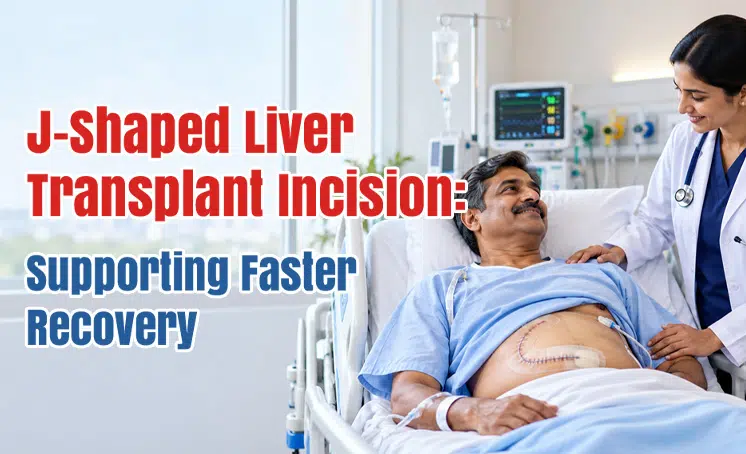
Your surgeon has recommended a liver transplant. The word “incision” comes up. You don’t know what that means for your body. You don’t know how big the cut will be, where it sits, what your recovery will look like or whether the scar will affect how you move.
These are reasonable questions. Here are clear answers.
The J-shaped liver transplant incision is a surgical approach that reduces wound complications, lowers the rate of incisional hernia and supports faster post-operative recovery compared to older techniques. Transplant surgeons worldwide now prefer it over the older Mercedes-Benz approach, and the clinical evidence explains exactly why.
Dr. Amit Rastogi, Chairman of Liver Transplant and HPB Surgery at PSRI Hospital, New Delhi, leads a team with experience of over 1,200 liver transplants.
What Is a J-Shaped Liver Transplant Incision?
A J-shaped liver transplant incision is a surgical cut made in the upper abdomen during liver transplant surgery. It gets its name from the shape it traces on the body. The incision runs horizontally just below the right ribcage, then curves downward on the right side, forming the shape of the letter J.
Surgeons also call it the Makuuchi incision, named after the Japanese liver surgeon who helped establish it as a standard approach for liver surgery. The J-shape gives the surgical team access to the liver, bile duct, blood vessels and surrounding structures without cutting across both sides of the abdomen.
Key anatomical facts about the J-shaped incision:
- It runs horizontally below the right ribcage and curves downward on the right side
- It spans approximately 20 to 25 centimetres in total length
- It stays on the right side only, leaving the left flank completely undisturbed
- It avoids the vertical extension toward the breastbone that the Mercedes-Benz technique requires
What Are the Types of Incisions Used in Liver Transplant Surgery?
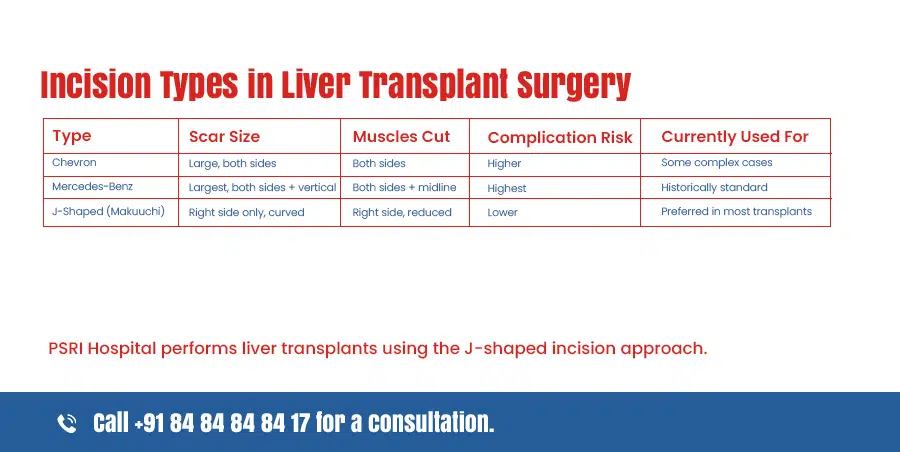
Three incision types exist in liver transplant surgery: Chevron, Mercedes-Benz and J-shaped (Makuuchi). Each gives the surgeon different access to the surgical field and carries different recovery implications.
| Incision Type | Shape | Where It Cuts | Key Feature |
|---|---|---|---|
| Chevron (Bilateral Subcostal) | Inverted V across both sides | Both sides of the upper abdomen | Wide access, both flanks |
| Mercedes-Benz | Bilateral subcostal with upward extension | Both sides plus up toward the breastbone | Maximum exposure, largest scar |
| J-Shaped (Makuuchi) | Right subcostal curving downward | Right side only, curves downward | Reduced muscle cutting, lower complication rate |
The Mercedes-Benz incision dominated liver transplant surgery for decades. Most leading transplant centres no longer use it as their first choice. It gave surgeons excellent exposure of the liver, but it came at a cost: a large bilateral scar, significant muscle cutting across both sides and a measurably higher rate of wound complications and incisional hernia.
The J-shaped incision preserves the left side of the abdomen entirely. It avoids the upward vertical extension. That’s what makes the liver transplant scar smaller and the recovery faster. Surgeons achieve comparable access to the liver with measurably less disruption to the abdominal wall.
Why Do Surgeons Choose the J-Shaped Incision?
The choice of incision in liver transplantation isn’t cosmetic. It directly affects how the patient heals, how painful the recovery is, how quickly they can breathe deeply and how likely they are to develop complications.
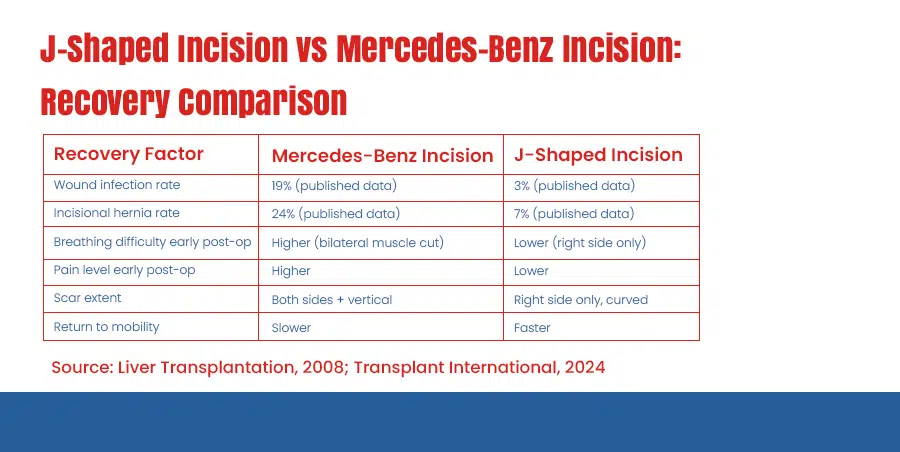
The clinical evidence is specific. A study published in the journal Liver Transplantation compared 58 consecutive patients who received the classic Mercedes-Benz incision with 60 patients who received a J-shaped incision. The results showed that early wound-related morbidity dropped from 19% in the Mercedes-Benz group to 3% in the J-shaped group. The incisional hernia rate dropped from 24% to 7%. Both results were statistically significant.
A 2024 study published in Transplant International, comparing outcomes across 255 patients in living donor liver transplantation, confirmed that the J-shaped approach cut pleuropulmonary complications and improved early post-operative recovery compared to other incision techniques. That single design difference drives every clinical advantage the J-shaped approach delivers.
Surgeons choose the J-shaped incision because:
- It avoids cutting the muscles on the left side of the abdomen entirely
- It doesn’t require the vertical extension toward the breastbone
- It provides adequate exposure to the liver for the full transplant procedure
- It reduces the surface area of the wound, which directly reduces infection risk
- It lowers the mechanical stress on the abdominal wall during healing
- It’s reproducible across different patient body types and anatomies
How Does the J-Shaped Incision Support Faster Recovery?
The J-shaped incision cuts less muscle, causes less pain, triggers fewer breathing complications and produces a significantly lower hernia rate than the Mercedes-Benz approach. Every one of those differences accelerates early recovery in the weeks after surgery.
Less Muscle Cutting, Less Pain
The J-shaped incision avoids bilateral muscle cutting. The abdominal muscles on the left side stay intact. Less muscle disruption means less post-operative pain, which means the patient can breathe more deeply sooner and start moving earlier.
Fewer Breathing Complications
The Mercedes-Benz incision’s vertical extension disrupts the mechanics of breathing during early recovery. Patients struggle to breathe deeply, which raises the risk of pneumonia and pulmonary complications. The J-shaped approach avoids that entirely. The 2024 Transplant International study confirmed that J-shaped incision patients experienced significantly fewer pleuropulmonary complications during early post-operative recovery.
Lower Wound Infection Risk
A smaller wound surface directly reduces infection risk. The J-shaped incision covers less surface area than the Mercedes-Benz design, and the published literature consistently shows fewer wound infections as a direct result.
Significantly Lower Hernia Rate
Incisional hernia is a common long-term complication of liver transplant surgery. It’s painful, limits activity and often needs another operation to repair. The J-shaped approach reduced the incisional hernia rate from 24% to 7% in the Liver Transplantation journal comparison study. That’s not a minor difference. For a patient already managing immunosuppression and follow-up care, that’s a surgery they don’t need.
Smaller Scar, Better Acceptance
The J-shaped scar runs along the right side of the abdomen only. Patients consistently report that the cosmetic outcome affects their psychological recovery and their willingness to pursue transplantation when they’re hesitant. A smaller, more contained scar helps patients feel less defined by their surgery. That matters when they’re trying to return to normal life.
What Does Recovery After a Liver Transplant Look Like?
Most patients stay in hospital for two to three weeks after liver transplant surgery. Full return to normal daily activity takes three to six months. Individual timelines vary based on the patient’s pre-transplant condition, donor type and how the surgery went.
In the hospital (typically 2 to 3 weeks):
- The first 24 to 72 hours take place in the ICU for close monitoring of liver function, bleeding and rejection
- Drains remove fluid from around the surgical site
- Immunosuppression medication starts immediately to prevent rejection
- The patient moves from ICU to a general ward as stability improves
- The surgical team monitors liver enzymes, bilirubin and clotting factors daily
First three months at home:
- Activity gradually increases from short walks to longer distances
- Driving and heavy lifting stay restricted for six to eight weeks
- Regular follow-up visits to the transplant centre to adjust immunosuppression
- Blood tests every week initially, then progressively less frequent
- Wound care continues until full healing is confirmed
Beyond three months:
- Some patients return to work by three months depending on their job type
- Long-term immunosuppression continues indefinitely
- Annual check-ups with the transplant team monitor liver function and overall health
The J-shaped incision does its most important work in the first three months. Less pain, fewer breathing complications and a lower hernia risk free the patient to focus on rehabilitation. For patients recovering in Delhi NCR, the transplant team at PSRI Hospital monitors progress closely through this period with scheduled follow-up appointments.
What to expect from your wound in the first week:
- The wound area will feel tender and tight. This is normal and improves steadily.
- The surgical team changes dressings and monitors drainage from any tubes placed during surgery
- Mild swelling and bruising around the incision site is expected and typically resolves within two weeks
- See a doctor immediately if the wound shows increasing redness, warmth, discharge or if you develop a fever above 38°C
Who Needs a Liver Transplant?
A liver transplant replaces a diseased liver with a healthy one from a living or deceased donor. Surgeons consider it when the liver can no longer perform its essential functions and no other treatment can restore them.
Conditions that commonly lead to liver transplant evaluation include:
- End-stage liver disease from cirrhosis caused by hepatitis B, hepatitis C, alcoholic liver disease or non-alcoholic fatty liver disease
- Acute liver failure from drug overdose, viral hepatitis or autoimmune liver disease
- Primary biliary cholangitis and primary sclerosing cholangitis
- Early-stage liver cancer that meets the transplant criteria (Milan criteria)
- Genetic liver conditions including Wilson’s disease, haemochromatosis and alpha-1 antitrypsin deficiency
- Biliary atresia in children
The transplant surgeon determines the surgical approach, including the choice of incision, based on the patient’s anatomy, body weight, previous surgeries and the size of the donor liver. For most adult patients undergoing living donor liver transplantation, the J-shaped incision offers advantages in both the surgical access and the recovery trajectory. Families searching for the best hospital for liver transplant in Delhi or the best liver transplant hospital in India consistently evaluate both surgical expertise and post-transplant support. Both matter equally. For patients seeking liver transplant care at PSRI Hospital, the team evaluates each case individually before recommending a surgical plan.
When Should You Consult a Liver Transplant Centre?
See a liver transplant centre when your liver disease progresses beyond what medication and lifestyle can manage. For patients across Delhi NCR searching for a multispeciality hospital near me that offers full transplant services, PSRI Hospital provides that evaluation under one roof.
Seek evaluation at a liver transplant centre if:
- Your liver specialist has mentioned cirrhosis and you haven’t been formally assessed for transplant candidacy
- Your MELD score (a measure of liver disease severity) is rising, particularly above 15
- You’ve developed complications of liver failure: ascites that doesn’t respond to diuretics, hepatic encephalopathy or variceal bleeding
- You’ve been diagnosed with early liver cancer and liver transplant is being considered
- Acute liver failure has developed rapidly and medical management isn’t stabilising you
- A family member has been told they may be a suitable living donor and you want to explore this option
A transplant evaluation isn’t a commitment. It’s information. The team checks your eligibility, reviews your medical history, evaluates potential living donors if applicable and explains what’s involved. Going through the evaluation gives you options. Waiting removes them.
For patients looking for a liver transplant hospital in Delhi or wondering about preventive care before advanced liver disease sets in, early consultation determines what’s still possible.
Book a Liver Transplant Consultation at PSRI Hospital Now
If your liver disease has reached the point where a transplant is being discussed, you need a centre where surgical expertise, post-operative care and long-term follow-up are all in the same place.
PSRI Hospital, the best liver transplant hospital in India for patients from Delhi NCR and across the country, offers coordinated liver transplant care from initial evaluation through surgery and lifelong follow-up.
Dr. Amit Rastogi, Chairman of Liver Transplant and HPB Surgery at PSRI Hospital, leads a team with over 1,200 successful liver transplant procedures. His team performs both living donor liver transplantation and deceased donor liver transplantation, using the J-shaped incision approach to support faster post-operative recovery and reduce long-term wound complications.
Why Patients Choose PSRI Hospital for Liver Transplant:
- Best hospital for liver transplant in Delhi, with 1,200 or more completed procedures
- Liver transplant hospital in India trusted by patients from Delhi NCR and across the country
- J-shaped incision technique for reduced complications and faster recovery
- Dedicated transplant ICU, hepatology team and post-transplant follow-up programme
- NABH and NABL accredited multispeciality hospital near me, located at Sheikh Sarai II, near Saket Court, New Delhi
- Accessible from Malviya Nagar, Panchsheel Park, Greater Kailash, Hauz Khas and South Delhi
If you’ve been told a liver transplant is needed, or if you want to understand your options before the decision becomes urgent, call today.
Call +91 84 84 84 84 17 to book your liver transplant consultation at PSRI Hospital, Press Enclave Marg, Sheikh Sarai II, near Saket Court, New Delhi 110017.
Frequently Asked Questions
What is a J-shaped incision in liver transplant surgery?
A J-shaped incision is a surgical cut below the right ribcage that curves downward, forming a J shape. It gives the surgeon access to the liver while cutting fewer muscles than older techniques, reducing complications and recovery time.
How big is the scar after a liver transplant?
A J-shaped incision spans approximately 20 to 25 centimetres along the right side of the abdomen. It’s smaller than the Mercedes-Benz incision, which extends across both sides and upward. The J-shaped scar heals well and stays contained to the right side.
How long does recovery take after a liver transplant?
Most patients spend two to three weeks in hospital after a liver transplant. Full return to daily activity typically takes three to six months. The J-shaped incision supports faster early recovery through reduced pain and fewer breathing complications.
What’s the difference between a J-shaped and Mercedes-Benz incision in liver transplant?
The Mercedes-Benz incision cuts across both sides of the abdomen with a vertical extension upward. The J-shaped incision stays on the right side only and curves downward. Published studies show the J-shaped approach cuts wound infection rates from 19% to 3% and hernia rates from 24% to 7%.
Is PSRI Hospital a good choice for liver transplant in Delhi?
PSRI Hospital has performed over 1,200 liver transplants and is among the best hospitals for liver transplant in Delhi and one of the best liver transplant hospitals in India. The team is led by Dr. Amit Rastogi and offers full transplant services from evaluation through long-term follow-up.