Book An Appointment
 Virtual Consultation
Hypertension: Symptoms , Causes & Treatment

FACT CHECKED
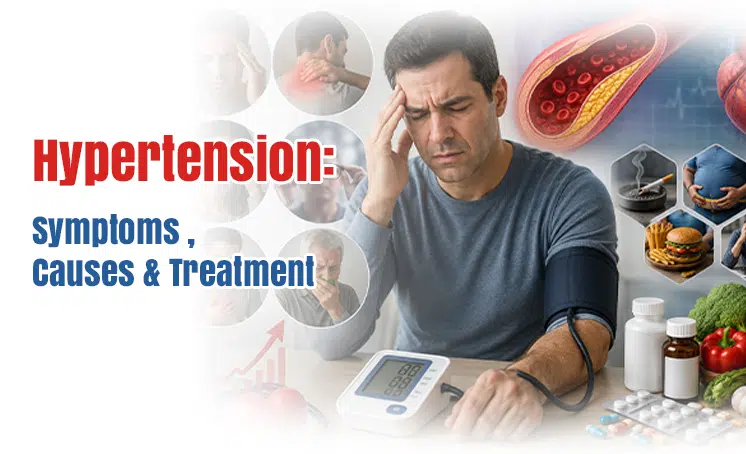
Your father takes a small white tablet every morning. Your neighbour had a sudden headache that turned serious. Your own reading at the chemist came back high and you haven’t gone back. That’s how most families live with hypertension. Quietly.
Around 220 million Indians have high blood pressure. Most don’t know it. It doesn’t hurt. There’s no warning. Just silent pressure building while everything feels normal.
At PSRI Hospital, best-rated multispeciality hospital in Delhi, high BP isn’t treated as a number to bring down. The team finds out why it’s high and what’s driving it. With a Cardiac Sciences Institute and specialists covering every condition that travels with hypertension, you get clear answers without being sent elsewhere. Thousands of patients across Delhi NCR have been treated here. It’s a safe place to start.
This blog covers the symptoms, causes, and treatment of hypertension, and when to act.
What Are the Hypertension Symptoms Most People Ignore?
Here’s the uncomfortable truth: most people with high BP don’t feel any different.
The body quietly adjusts to rising pressure over months and years. You feel fine. Your BP keeps climbing. Damage keeps building in the arteries and organs. The hypertension symptoms that do appear are easy to blame on something else entirely.
If you’ve been having any of these, don’t dismiss them:
- Morning headache at the back of your head, the kind that’s there when you wake up
- Dizziness or lightheadedness that comes and goes without a clear reason
- Blurred or double vision, even briefly
- Shortness of breath doing something that never tired you before
- A pounding or throbbing feeling in your chest or head
None of these confirm hypertension on their own. Each one is reason enough to get a BP reading done today.
What Actually Causes Hypertension and Are You at Risk?
Most people assume hypertension happens to older relatives or heavy smokers. The reality is more uncomfortable. There are two types.
- Primary Hypertension, which is by far the most common, builds slowly over years. There’s no single cause. It’s your genes, your age, what you eat, how much you move, and how much stress you carry.
- Secondary Hypertension is caused by something specific like kidney disease, thyroid problems, or sleep apnoea. It’s less common but moves faster and needs its own treatment path.
According to a 2024 review in Hypertension Research (PubMed PMID 38379011), hypertension is rising fastest among young and rural Indians. Indians also develop it about a decade earlier than people in Western countries.
Look at This List Honestly:
- Salt. The ICMR National NCD Monitoring Survey, published in Scientific Reports (2023), found the average Indian adult eats 8g of salt daily. The WHO limit is 5g. We’re eating nearly double without realising it.
- Sitting Most of the Day. Whether it’s a desk job or long hours at home, physical inactivity keeps BP consistently higher.
- Being Overweight. The heart has to push harder to move blood through a larger body.
- Stress That Never Fully Switches Off. Deadlines, family pressure, financial worries. Chronic stress keeps BP elevated even when you feel like you’re coping.
- Smoking. Every cigarette stiffens and narrows artery walls. Years of this calcifies the damage.
- Diabetes or High Cholesterol. These conditions and high BP almost always appear together.
- A Parent or Sibling With Hypertension. Your genetic risk is real and worth knowing.
If three or more of these hypertension causes apply to you and you’re 35 or older, don’t wait for a symptom. Speak to a doctor before one appears.
What Does Hypertension Treatment Actually Involve?
The good news: hypertension treatment works. It’s not complicated. It’s just consistent. It runs on two tracks and most people need both once readings reach Stage 1 or above.
Lifestyle Changes That Actually Move the Numbers:
- Cut Salt Below 5g a Day. Read the label on your atta biscuits, your namkeen, your instant noodles. The salt is already there before you add any.
- Walk 30 Minutes, Five Days a Week. Brisk walking consistently brings BP down over weeks. Not running. Just walking.
- Quit Smoking. Every cigarette you stop is one less spike to the arteries. The benefit starts from the first day you stop.
- Limit Alcohol. More than one drink a day keeps pressure elevated in ways most people don’t connect.
- Sleep Properly. Poor sleep raises the stress hormones that push BP up overnight. Seven to eight hours matters more than you’d think.
- Find a Way to Decompress. Breathing exercises, evening walks, even just stepping away from your phone for 20 minutes. Whatever consistently works for you.
When Your Doctor Adds Medication:
Lifestyle alone isn’t always enough, especially once BP is at Stage 1 or Stage 2. Your doctor will choose from four main types based on your readings, age, and what else is going on in your health:
- ACE Inhibitors block a hormone that tightens blood vessels, letting them relax
- Beta-Blockers reduce how hard and fast the heart pumps
- Calcium Channel Blockers stop calcium from entering heart muscle cells, relaxing the vessels
- Diuretics help the kidneys flush out extra salt and water, lowering blood volume
Medication controls hypertension. It doesn’t cure it. Once it’s working and your BP is stable, stopping it without advice brings pressure straight back up.
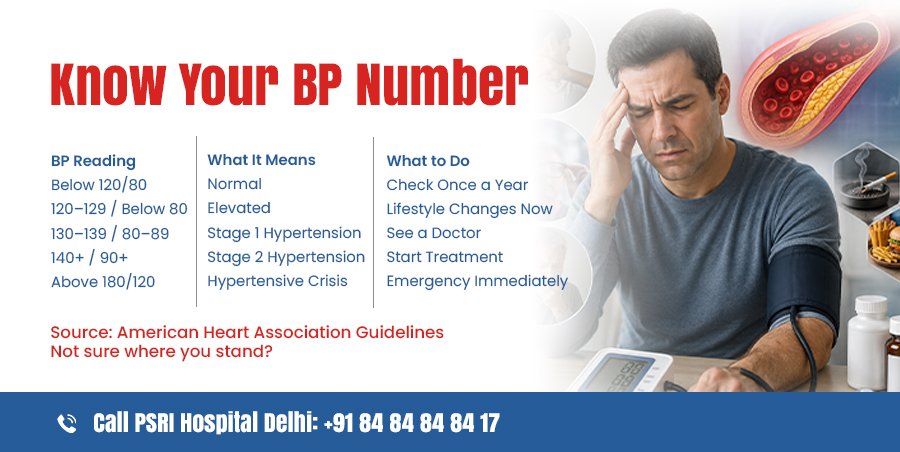
Go to Emergency Immediately If: Your BP reads above 180/120, or you have chest pain, a sudden severe headache, vision loss, or difficulty breathing. These are signs of a hypertensive crisis. Don’t wait it out at home.
Don’t Ignore Your BP Reading Anymore! Visit the Best Cardiologist in Delhi Now!
High BP doesn’t feel like much. That’s the problem most people don’t take seriously until it’s too late.
The pressure builds quietly over years. By the time a headache or breathlessness makes you stop, the arteries have been under strain for a long time. Most people discover hypertension through a routine check, not a symptom.
At PSRI Hospital, Delhi, our team investigates what’s actually driving your BP, not just the number. Dr Ravi Prakash, who authored the cardiology textbook chapter on hypertension, handles complex cases. Dr Manish Mohil manages hypertension alongside diabetes and metabolic conditions, exactly how most Indian patients present.
As a multispeciality hospital in Delhi and a 24 hours emergency hospital near me for patients across Delhi NCR, PSRI is rated 4.3/5 across nearly 7,000 patient ratings.
Don’t wait for a symptom to push you. Call +91 84 84 84 84 17 to book at PSRI Hospital, Delhi.
Frequently Asked Questions
What Is a Normal Blood Pressure Reading?
Below 120/80 mmHg is normal. At 130/80 or above, it’s hypertension. The infographic above shows what each reading means and what to do at each stage.
Can Hypertension Be Cured Completely?
It can’t be cured, but it can be fully controlled. Most people keep their BP in a normal range long-term with the right combination of lifestyle changes and medication. The condition comes back if treatment stops without medical advice.
What Are the Early Hypertension Symptoms to Watch For?
Most people have none at all. When they do appear, watch for morning headaches at the back of the head, dizziness, blurred vision, or breathlessness during activity you used to manage easily. Any one of these warrants a check.
Can Stress Alone Cause Hypertension?
On its own, stress is rarely the sole cause. But it keeps BP elevated day after day. Combined with a high-salt diet, physical inactivity, or a family history, it becomes a significant driver. Most Indian households carry all of these at once.
Is Hypertension Dangerous If I Feel Completely Fine?
Yes. That’s exactly the risk. Hypertension has no reliable early symptoms. The pressure builds, the damage accumulates, and most people find out only through a reading or a health event. A normal daily routine is not confirmation that BP is normal.
What Are the Main Hypertension Causes?
Primary hypertension builds slowly from a mix of genetics, age, diet, inactivity, and stress. Secondary hypertension comes from a specific condition like kidney disease or a thyroid problem. Both types need evaluation. A BP number alone doesn’t tell you which type you’re dealing with or what’s driving it.