Book An Appointment
 Virtual Consultation
World Physiotherapy Day 2026: Smart Ergonomics to Defeat the Desk Hump

FACT CHECKED
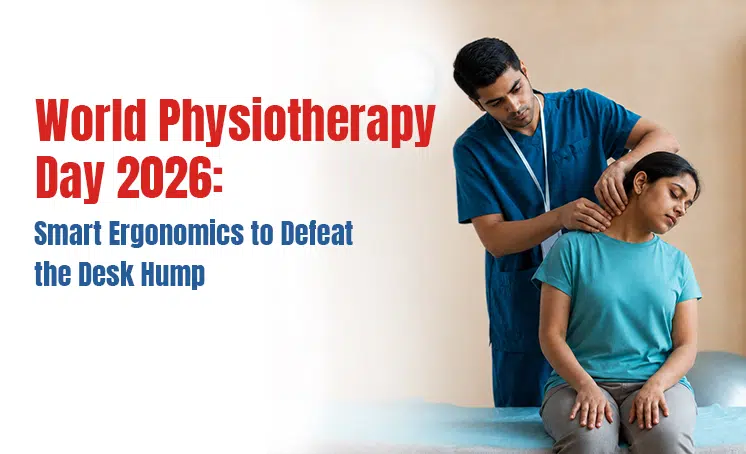
You’ve been at your desk for three hours. Your neck aches. Your shoulders have crept forward. The upper spine has rounded into a curve. That’s the desk hump, and it won’t go away on its own.
It’s forward head posture combined with kyphosis (the rounding of the upper spine). Every inch the head drifts forward adds roughly 10 pounds of load on the cervical spine, which is the seven bones in your neck. At a 60-degree tilt, that load hits close to 60 pounds.
At PSRI Hospital, Delhi, we’re a NABH-accredited multispeciality hospital in Delhi treating posture and musculoskeletal conditions since 1996. Our physiotherapy department covers ergonomic assessment, orthopaedic rehabilitation, and pain management.
This blog covers what causes the desk hump, the 5-minute ergonomic reset, and the exercises that actually correct it.
Why Is World Physiotherapy Day 2026 Important for Desk Workers in India?
Neck pain among Indian desk workers isn’t rare. It’s the norm. A 2024 systematic review in the Journal of Occupational Health found neck pain affects 40% of workers across occupational sectors in India. A study from AIIMS New Delhi found work-related neck pain in 28.3% of desk workers. Poor screen height and bad posture were the strongest predictors in both.
Post-COVID hybrid work made it worse:
- Home setups replaced ergonomic office chairs and desks
- Commutes dropped, so people sat for longer without moving
- Screen hours went up with no one checking if the setup was safe
World Physiotherapy Day is observed every year on September 8 to change this. It asks people to take posture seriously before it becomes a pain condition.
This year, India is at the centre of the global conversation. The World Physiotherapy AWP Regional Conference is in New Delhi for the first time. It runs on September 26 and 27, 2026, at the Yashobhoomi Convention Centre. The theme is “Fitness for All: Empowering Communities, Building Inclusive Health.”
What Causes the Desk Hump and Why Won’t It Fix Itself?
The desk hump isn’t from one bad day at your desk. It’s the same wrong position, repeated hundreds of times.
Three setup mistakes drive it:
- Screen too low pulls your head forward and down
- Chair too high tips your pelvis back and collapses your lower spine
- Keyboard too far makes your shoulders reach forward and round
Each one loads the wrong muscles. Over months, the body stops trying to correct the position and just holds it.
What makes it hard to fix on your own:
- Tight chest and neck muscles keep pulling the head and shoulders forward, even when you’re away from the desk
- Weak upper back muscles have stopped firing. They can’t pull the shoulders back anymore.
- Stiff spinal joints have lost their range. They won’t straighten even when you try.
Standing up straighter won’t fix it. The muscles aren’t strong enough to hold it. You need two things: ergonomic changes to stop the daily damage, and specific exercises to undo what’s already built up.
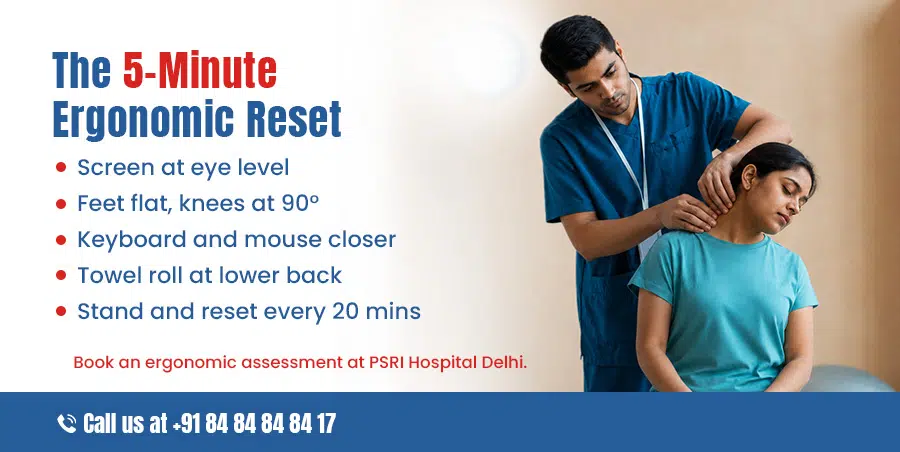
What Is the 5-Minute Ergonomic Reset?
These five adjustments take five minutes. They don’t need new furniture. They reduce the load on your neck and upper back every single hour you sit.
- Raise your screen to eye level. The top of your monitor should sit at or just below eye height. When it drops lower, your head follows it. A stack of books or a monitor stand works fine.
- Set your chair so your feet sit flat. Feet flat on the floor. Knees at 90 degrees. If your feet hang, your pelvis tips back and your head moves forward. Put a footrest or a thick hardback book under your feet.
- Move your keyboard and mouse closer. Your elbows should bend at 90 degrees without reaching forward. Every centimetre you reach pulls your shoulders and head with it.
- Support your lower back. Roll a small towel. Tuck it behind your lower back so the curve of your spine touches the chair. Without it, your upper back rounds and your neck leads forward.
- Stand up every 20 minutes. Set a phone alarm. When it goes off: stand, look 20 feet away for 20 seconds, roll your shoulders back twice. Under one minute. It tells your neck muscles they don’t have to hold one position forever.
These five changes stop the daily damage. They don’t undo what’s already there. That’s what the exercises below are for.
Which Exercises Actually Correct the Desk Hump?
These five exercises take under 10 minutes a day. Each one targets a specific problem the desk hump creates in your body.
Before you start: tingling in your arm or fingers, shoulder pain, or morning stiffness means see a physiotherapist first.
Doorway Chest Stretch – Releases tight chest muscles that pull the shoulders inward
Stand in a doorway. Arms at shoulder height, forearms on the frame. Step one foot forward until you feel a stretch across your chest. Hold 30 seconds. Repeat twice.
Neck Side Stretch – Releases the muscle running from your skull base to your shoulder
Sit upright. Drop your right ear toward your right shoulder. Place your right hand gently on the left side of your head for extra pull. Hold 20 to 30 seconds. Switch sides. Twice each side.
Chin Tucks – Reactivates the small neck muscles that keep your head upright
Sit or stand straight. Two fingers on your chin. Slide your head straight back (not down) until you feel the back of your neck lengthen. Hold 3 seconds. Do 10 reps, twice a day.
Shoulder Blade Squeezes – Wakes up the upper back muscles that stopped pulling the shoulders back
Sit or stand, arms relaxed. Pull your shoulder blades together. Hold 5 seconds. Repeat 15 times.
Towel Roll Back Extension – Restores the natural curve your upper spine lost from rounding forward
Roll a bath towel into a firm cylinder. Lie back on it across your upper back at shoulder blade level. Never under the neck. Let your back extend gently over it for 30 seconds. Shift it one hand-width lower. Repeat.
Still in Pain? Visit a Physiotherapist at PSRI Hospital, Delhi!
If the neck ache has lasted more than three months, home exercises won’t fix it. The same goes if the hump’s visible even when you sit straight. The muscles are too tight or too weak. The joints may have lost range they won’t recover without hands-on treatment.
At PSRI Hospital, Delhi, here’s what a physiotherapy assessment covers:
- Which muscles are short and which are weak. Exercises alone won’t work if you’re targeting the wrong ones.
- Manual therapy (hands-on treatment to restore joint movement) for what exercises can’t reach on their own
- A posture and exercise plan built around how you actually sit and work, not a generic protocol
The physiotherapy department at PSRI Hospital in Delhi covers posture assessment, orthopaedic physiotherapy, pain management, and in-patient and out-patient rehabilitation. We’re a multispeciality hospital in Delhi with 30+ departments and round-the-clock emergency care. We’ve treated patients from across Delhi NCR and internationally since 1996.
Don’t wait for neck pain to become a nerve problem. Call +91 84 84 84 84 17 to book a consultation.
Frequently Asked Questions
When is World Physiotherapy Day 2026?
September 8. It’s observed globally every year to promote physiotherapy and push people to address musculoskeletal conditions before they get serious.
What is the desk hump and can it be reversed?
The desk hump is forward head posture combined with kyphosis (rounding of the upper spine). Yes, it can be reversed. Consistent ergonomic fixes and daily targeted exercises correct it in 6 to 12 weeks. Cases with nerve involvement take longer and need clinical physiotherapy.
How long does it take to fix forward head posture?
Visible improvement comes in 2 to 4 weeks with daily exercises and ergonomic changes. Full correction takes 6 to 12 weeks. If there’s nerve involvement or significant joint stiffness, clinical physiotherapy is needed and results take longer.
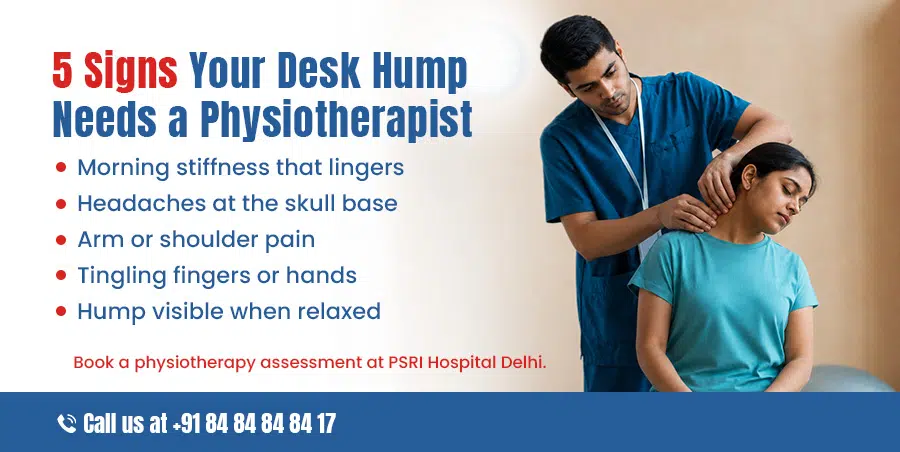
What are the red flags that mean I need a physiotherapist?
Morning stiffness that takes time to ease. Headaches starting at the skull base. Shoulder or arm pain. Tingling or numbness in the fingers. A hump visible when you’re relaxed. Any one of these means get assessed before starting home exercises.