Book An Appointment
 Virtual Consultation
How Neuro Navigation Technology Improves Brain Surgery Accuracy

FACT CHECKED
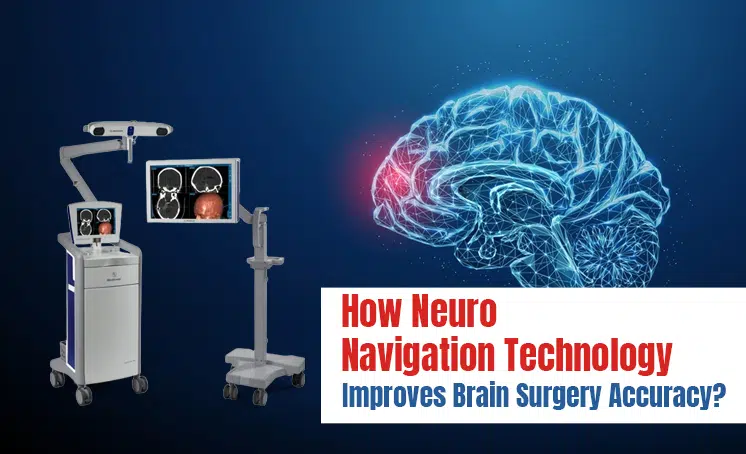
Brain surgery requires exact target localisation, controlled access, and continuous anatomical orientation. What is Neuro-navigation is a common question when patients and caregivers review advanced neurosurgical technology before treatment.
Neuro-navigation is a computer-guided system that works like a GPS platform for the brain. It combines imaging, 3D mapping, and real-time instrument tracking to help surgeons identify the target area, plan the surgical route, and navigate with greater precision during the procedure.
At PSRI Hospital, advanced neurosurgery includes image-guided procedures, neuronavigation-guided surgery, and dedicated neuro operation theatres for precision-focused brain and spine care.
This blog explains how the neuro-navigation technology works, where it is used, and why it matters in modern neurosurgical treatment.
What Is Neuro Navigation Technology In Brain Surgery?
Neuro-navigation is a computer-guided surgical system that helps neurosurgeons reach the exact operative area with greater precision.
In practical terms, what is neuronavigation? It is an image-guided platform that uses preoperative scans and navigation software to show the surgeon where the lesion is, where nearby critical structures are located, and where the surgical instruments are in real time. This helps improve anatomical orientation before and during surgery.
At PSRI Hospital, neuronavigation-guided surgery is used as part of advanced brain surgery planning and execution.
What The System Helps The Surgeon Do?
- Localise the target area more precisely.
- Plan the safest and most effective surgical corridor.
- Track instruments against mapped anatomy in real time.
- Protect nearby functional structures through better spatial guidance.
This is why neuronavigation in brain tumour surgery is closely associated with more accurate localization and more controlled operative planning.
Why Accuracy Matters In Brain Surgery?
Accuracy matters in brain surgery because lesions are often located near structures responsible for movement, speech, memory, vision, and sensation.
Even a small deviation can affect healthy tissue around the operative target. This is why modern neurosurgery depends on precise imaging, route planning, and real-time anatomical guidance. Navigation systems improve surgical orientation by combining imaging data with intraoperative tracking. They help the surgeon visualise anatomy in 3D, plan the operative path, and identify lesion boundaries more clearly.
Why Precision Is Critical?
- Complex Brain Anatomy requires exact spatial awareness.
- Healthy Tissue Preservation matters for neurological function after surgery.
- Trajectory Planning affects how safely the lesion is approached.
- Intraoperative Orientation supports better surgical control.
These are some of the core benefits of neuronavigation in precision-based cranial surgery.
How Neuro Navigation Works During Brain Surgery?
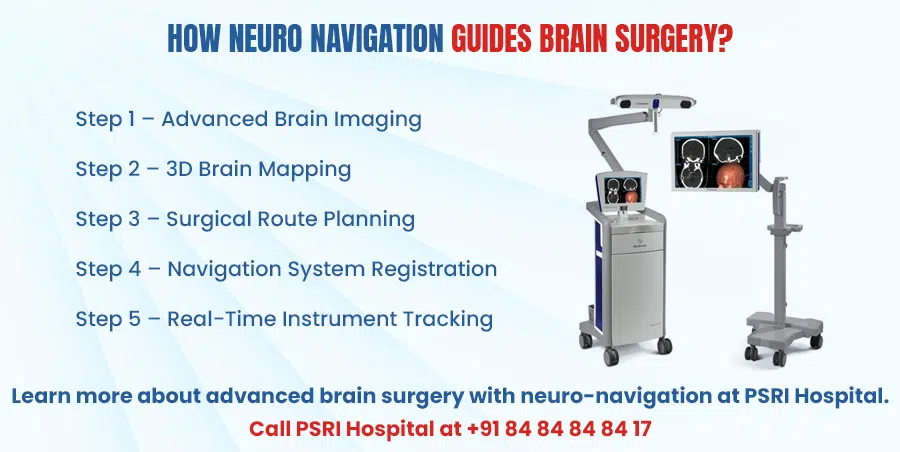
Neuro-navigation works by integrating imaging scans, 3D anatomical mapping, surgical planning, and real-time navigation during the procedure. Here’s the step-by-step details of how it works!
- Brain Imaging Scans. MRI, CT, and other imaging studies define the lesion and its relationship to surrounding anatomy. At PSRI Hospital, advanced brain tumour evaluation begins with detailed imaging to confirm tumour type, location, and treatment approach.
- 3D Mapping Of The Brain. The imaging data is converted into a 3D anatomical model. This allows the surgeon to review the lesion, surrounding tissue, vessels, and critical structures before surgery starts.
- Surgical Planning. The surgeon plans the craniotomy, route, and operative corridor based on mapped anatomy. Navigation platforms are designed to support route selection and least-disruptive access where possible.
- Real-Time Navigation During Surgery. During the operation, the system tracks instruments against the mapped anatomy. This helps maintain target accuracy and improves orientation throughout the case.
This workflow explains why neuronavigation in brain tumor surgery is especially valuable when exact target localisation and controlled access are required.
Which Conditions Are Treated Using Neuro Navigation?
Neuro-navigation is used in brain and spine procedures where exact localization and route planning are important.
Common Uses of Neuro-Navigation Include
- Brain Tumours.
- Spine Tumours.
- Epilepsy Surgery.
- Brain Biopsies.
- Skull Base Surgery.
At PSRI Hospital, advanced neurosciences care includes treatment for brain tumours, epilepsy, and spine conditions, with neuronavigation-guided surgery forming part of precision-focused operative care.
Benefits Of Neuro Navigation Technology For Patients
The main patient benefits come from better localisation, better route planning, and better preservation of surrounding healthy tissue.
Key Benefits For Patients
- Higher Surgical Precision.
- Reduced Damage To Healthy Tissue.
- Smaller Surgical Openings In Selected Cases.
- Lower Complication Risk Through Better Planning.
- Faster Recovery In Suitable Cases.
The exact outcome still depends on the disease, its location, and the type of surgery. Even so, these are among the most important benefits of neuronavigation because the system is designed to improve target definition, route accuracy, and intraoperative control.
Who May Need Brain Surgery With Neuro Navigation?
Patients with lesions that require high anatomical accuracy may be candidates for surgery planned with neuro-navigation support.
This technology is commonly relevant in situations such as:
- A Diagnosed Brain Tumour that requires precise localisation.
- Persistent Neurological Symptoms linked to a structural lesion.
- Seizures Not Controlled With Medicines when surgery is being considered.
- A Deep Or Difficult-To-Reach Lesion where route planning is critical.
- Spine Or Skull Base Pathology where anatomy is complex.
At PSRI Hospital, advanced imaging and surgical planning are central to brain tumour and epilepsy treatment. Patients researching the brain tumor surgery cost in Delhi often also want to understand whether the centre uses precision-guided technology that supports surgical accuracy.
Why Advanced Surgical Technology Matters In Brain Treatment?
Advanced surgical technology matters because complex brain treatment depends on mapping, planning, and real-time anatomical guidance.
Modern neurosurgical care uses image guidance, neuro-navigation, high-end microscopes, neuro-endoscopes, and specialised operating theatres to improve surgical control. At PSRI Hospital, advanced neurosurgery is supported by image-guided procedures and dedicated neuro operation theatres equipped for precision-based brain and spine surgery.
Why Technology Improves Surgical Control?
- Better Visualisation of the lesion and surrounding anatomy.
- Structured Preoperative Planning before incision.
- More Accurate Instrument Tracking during surgery.
- Better Intraoperative Orientation in complex cases.
Why Choose PSRI Hospital For Advanced Neurosurgery?
PSRI Hospital combines experienced neurosurgeons, advanced surgical technology, multidisciplinary care, and structured patient support for complex brain and spine treatment.
- Experienced Neurosurgeons. Brain tumour surgery, complex cranial procedures, and advanced spine interventions are handled by a specialist neurosurgery team.
- Advanced Surgical Technology. Neuro-navigation, image-guided neurosurgery, dedicated neuro operation theatres, high-end microscopes, and neuro-endoscopes support greater surgical accuracy.
- Multidisciplinary Care. Brain and spine cases benefit from coordinated evaluation, treatment planning, surgery, and recovery support across specialties.
- Patient Support And Follow-Up. Treatment pathways include pre-surgical planning, post-operative monitoring, and continuity of care after surgery.
For readers comparing centres, this is why PSRI Hospital can be considered among the best hospital for brain tumor surgery in Delhi when specialist expertise and precision-guided surgical infrastructure are both priorities. Patients reviewing the brain tumor surgery cost in Delhi also need clarity on technology, team experience, and follow-up care before making a treatment decision.
When Should You Seek A Second Opinion Before Brain Surgery?
A second opinion is useful when the diagnosis, treatment plan, or need for surgery requires additional review.
It is particularly relevant when:
- The Diagnosis Needs Confirmation.
- You Want To Compare Surgical Approaches.
- You Need More Clarity On The Role Of Technology.
- The Risks, Timing, Or Recovery Plan Need Review.
At PSRI Hospital, the second opinion pathway helps patients review diagnosis, treatment recommendations, and next-step decisions with more clarity before proceeding. Internal link for this section:
Conclusion
Neuro-navigation improves brain surgery accuracy by combining imaging, 3D mapping, trajectory planning, and real-time anatomical guidance during the procedure. This supports more precise target localisation, better preservation of healthy tissue, and more controlled surgical execution in selected cases.
At PSRI Hospital, advanced neurosurgery combines specialist expertise, precision-guided technology, and coordinated patient care for complex brain and spine treatment. That is one reason families evaluating the best hospital for brain tumor surgery in Delhi also look closely at technologies such as neuro-navigation before finalising treatment.
Call PSRI Hospital at +91 84 84 84 84 17 for more details.
FAQs
Is Neuro Navigation Surgery Safe?
Neuro-navigation is designed to improve guidance, localisation, and surgical planning. It can support safer target access, but overall surgical safety still depends on the pathology, lesion location, procedure type, and patient condition.
How Accurate Is Neuro Navigation Technology?
Navigation systems are built to improve localisation and instrument tracking using image-based mapping and real-time guidance. Their practical accuracy depends on imaging quality, registration, anatomy, and intraoperative conditions, but the main purpose is more precise targeting than unguided surgery.
Does Neuro Navigation Reduce Surgery Risk?
It can help reduce certain risks by improving route planning, tissue localisation, and intraoperative orientation. It does not remove all surgical risk, but it gives the surgeon more information and more control during the procedure.
How Long Does Recovery Take After Brain Surgery?
Recovery depends on the condition treated, the type of surgery, neurological status, and the post-operative care plan. Patients comparing the best hospital for brain tumor surgery in Delhi often review not only surgical technology, but also aftercare, rehabilitation support, and the brain tumor surgery cost in Delhi before choosing a centre.