Book An Appointment
 Virtual Consultation
Hematopoietic Stem Cell Transplant: How It Helps Treat Blood Cancers

FACT CHECKED
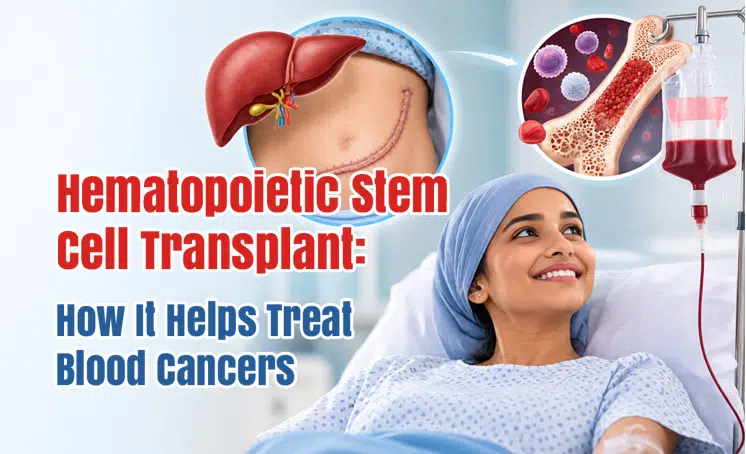
Your family member has leukemia. Chemotherapy started months ago. The cancer kept coming back. Now the haemato-oncologist mentions a stem cell transplant. You walk out of that room with one question: how does that actually help?
Here’s the answer.
A Hematopoietic Stem Cell Transplant (HSCT) helps in two ways. It replaces the diseased blood-forming system with healthy stem cells. And when the cells come from a donor, it gives the patient a new immune system that can hunt down cancer cells that survived chemotherapy. That second part is what makes HSCT different from anything chemotherapy can do.
India records approximately 50,000 new blood cancer cases every year, according to the Indian Society of Blood and Marrow Transplantation. Only around 30% of patients who need a transplant can access one. That gap is a problem. But for those who can access it, HSCT changes what’s possible.
Dr Amit Upadhyay, Senior Consultant in Haemato-Oncology and Bone Marrow Transplant at PSRI Hospital, New Delhi, works with patients who need this treatment. PSRI Hospital is recognised as the best hospital in Delhi NCR for specialist cancer care.
What Is a Hematopoietic Stem Cell Transplant and How Does It Work?
Think of stem cells as the factories your body uses to produce blood. Every red blood cell, white blood cell and platelet starts as a stem cell in the bone marrow. Blood cancers hijack those factories. Leukemia, lymphoma and multiple myeloma all start there, producing abnormal cells instead of healthy ones.
Chemotherapy kills many of those cancer cells. But the damaged marrow stays behind. HSCT clears it entirely and replaces it with healthy stem cells from either the patient or a donor.
But here’s what makes donor transplants different. The donor’s immune cells arrive alongside the new stem cells. They look at the patient’s remaining cancer cells, recognise them as foreign and attack them. Doctors call this the graft-versus-leukemia effect, or GvL. It’s the reason a donor transplant can achieve lasting remission in leukemia patients where chemotherapy alone keeps failing.
Chemotherapy treats what’s there now. HSCT rebuilds the system and, with a donor, gives that system a memory for fighting what’s left.
How Does HSCT Help Treat Specific Blood Cancers?
The way HSCT helps depends entirely on which blood cancer it’s treating. The disease drives the type of transplant, the timing and the goal.
| Blood Cancer | How HSCT Helps | Transplant Type |
|---|---|---|
| Acute Myeloid Leukaemia (AML) | Clears residual disease; GvL reduces relapse risk | Allogeneic |
| Acute Lymphoblastic Leukaemia (ALL) | Replaces high-risk marrow; GvL attacks remaining blast cells | Allogeneic |
| Chronic Myeloid Leukaemia (CML) | Used when targeted therapy stops working; GvL gives durable remission | Allogeneic |
| Hodgkin Lymphoma | Rescues patients after chemotherapy relapse | Autologous |
| Non-Hodgkin Lymphoma | Consolidates remission in high-risk or relapsed cases | Autologous or Allogeneic |
| Multiple Myeloma | Deepens remission after induction chemotherapy | Autologous |
| Myelodysplastic Syndrome (MDS) | The only potentially curative treatment; replaces defective marrow | Allogeneic |
| Aplastic Anaemia | Replaces marrow that stopped producing blood cells altogether | Allogeneic |
For leukemia, the GvL effect matters most. Donor immune cells keep patrolling the patient’s body after engraftment, destroying any leukemia cells that slipped through. That ongoing surveillance is the difference between remission that holds and remission that doesn’t.
How Do the Two Types of HSCT Help Differently?
The type of transplant changes how HSCT fights the cancer.
- Autologous HSCT uses the patient’s own stem cells, collected before high-dose chemotherapy. The chemotherapy clears the cancer. The stored cells then rebuild the blood system. The immune system stays the patient’s own, so there’s no GvL effect. It works best for multiple myeloma and relapsed Hodgkin lymphoma, where the goal is deepening remission after chemotherapy rather than generating a new immune attack.
- Allogeneic HSCT uses donor cells. This type generates the GvL effect. The donor immune cells actively attack residual cancer after engraftment. It’s the preferred approach for leukemia, MDS and aplastic anaemia, where that ongoing immune activity is what drives durable remission.
- Haploidentical transplants use a half-matched donor, typically a parent, child or sibling. This matters in India specifically. Finding a fully matched unrelated donor through registries is hard. Most patients do have a half-matched family member. That’s made haploidentical transplants increasingly accessible, and outcomes have improved significantly.
| Factor | Autologous HSCT | Allogeneic HSCT |
|---|---|---|
| Stem cell source | Patient’s own cells | Donor cells |
| GvL effect | No | Yes |
| Rejection risk | Minimal | Requires immunosuppression |
| Best for | Myeloma, relapsed lymphoma | Leukemia, MDS, aplastic anaemia |
| Donor needed | No | Yes |
Who Does HSCT Help Most?
Not every blood cancer patient needs HSCT. Not every patient who needs it can have it safely. Two questions drive eligibility: is the disease the right type and stage? And is the patient fit enough for what comes before the transplant?
HSCT helps most when:
- The cancer carries a high relapse risk with chemotherapy alone
- The disease has relapsed but still responds to treatment
- The cancer type generates a strong GvL response from donor cells
- The patient’s heart, lungs, kidneys and liver can handle the conditioning chemotherapy
- A suitable donor, matched or haploidentical, is available
HSCT isn’t the right choice when:
- The disease has progressed beyond what conditioning chemotherapy can control
- Organ function can’t withstand the intensity of the conditioning regimen
- An active, uncontrolled infection is present when the transplant is planned
Getting the timing right matters as much as finding a donor. Transplanting a high-risk AML patient in first remission produces significantly better outcomes than waiting for relapse. A haemato-oncologist determines that window. Early consultation at a multispeciality hospital in Delhi with dedicated haemato-oncology services gives patients more options, not fewer.
What Happens During HSCT That Helps the Cancer?
The transplant itself looks surprisingly simple. Patients describe Day 0 as looking like a blood transfusion. A bag of stem cells goes in through an IV line. But what happens before and after is where the treatment does its work.
Conditioning (Days -7 to -1)
High-dose chemotherapy, sometimes with radiation, clears the patient’s bone marrow. This destroys the cancer cells and makes room for the new stem cells to settle. It’s the hardest phase physically.
Day 0: The Transplant
The stem cells enter the bloodstream through an IV infusion. They travel to the bone marrow and start settling. Patients often say it looks like nothing. The real work starts later.
Engraftment (Days 10 to 30)
The new stem cells start producing blood cells. Counts begin rising. In allogeneic transplants, the donor immune cells establish themselves here and begin the GvL patrol.
GvL Ongoing (Beyond Day 30)
In allogeneic HSCT, the donor immune system continues searching for residual cancer cells for months, sometimes years. This is the mechanism that drives durable remission in leukemia. It doesn’t stop after the transplant. It keeps going.
What Does Recovery After HSCT Look Like?
Recovery is slow. The first 100 days are the hardest.
Blood counts stay low right after the transplant. That low count raises infection risk significantly. The transplant team manages this with isolation precautions, prophylactic antibiotics and daily monitoring of organ function.
Graft-versus-host disease (GvHD) isn’t a transplant failure. It’s a side effect of the thing that makes allogeneic HSCT work. Donor immune cells attack cancer, but they can also attack the patient’s healthy tissue, particularly the skin, gut and liver. Immunosuppressants control GvHD while keeping enough GvL activity intact to continue fighting the cancer.
Here’s what to expect at each stage:
- Day 30: Engraftment confirmed. Blood counts stabilise. Biggest infection risk starts to reduce.
- Day 100: First comprehensive disease reassessment. Most patients leave hospital before this point.
- 6 to 12 months: Most patients return to normal daily function. Full immune recovery happens for many.
When Should a Blood Cancer Patient Consider HSCT?
Most oncologists bring up HSCT when standard chemotherapy isn’t holding the cancer back well enough. If you’re hearing it mentioned in your treatment discussions, that’s the signal to get a haemato-oncology evaluation rather than waiting.
Talk to a haemato-oncologist about HSCT specifically when:
- Your oncologist mentions high-risk features in the diagnosis, like specific chromosomal changes in AML or ALL
- The cancer has relapsed after initial chemotherapy and still responds to treatment
- You’ve been diagnosed with MDS or aplastic anaemia that hasn’t responded to other approaches
- Targeted therapy for CML has stopped working
- You want a second opinion on whether HSCT fits your current disease stage
An evaluation covers disease staging, organ function tests, HLA typing for donor matching and a discussion of transplant type. Going through it gives you a clear answer. Patients searching for the best hospital in New Delhi for blood cancer evaluation will find specialist-led assessment at PSRI Hospital. For haemato-oncology and bone marrow transplant care, early evaluation determines what options remain open.
Book a Haemato-Oncology Consultation at PSRI Hospital Now
If HSCT has come up in your blood cancer treatment plan, get an evaluation first. Don’t decide without specialist input.
PSRI Hospital, recognised as the best hospital in Delhi NCR for multi-speciality tertiary care, offers haemato-oncology and bone marrow transplant services through an experienced oncology team. As a multispeciality hospital in Delhi established in 1996 and promoted by JK Organisation, PSRI covers diagnostic, medical oncology and oncosurgery services across all major cancer types.
Dr Amit Upadhyay, Senior Consultant in Haemato-Oncology and Bone Marrow Transplant at PSRI, evaluates HSCT candidacy, manages blood cancer treatment and coordinates donor assessment for allogeneic transplants.
Why Patients Choose PSRI Hospital for Blood Cancer Care:
- Haemato-oncology and bone marrow transplant services under one roof
- Evaluation for autologous, allogeneic and haploidentical HSCT
- Best hospital in New Delhi for integrated cancer and transplant evaluation
- NABH and NABL accredited, Sheikh Sarai II, near Saket Court, New Delhi
- Accessible from Malviya Nagar, Panchsheel Park, Greater Kailash and South Delhi
Call +91 84 84 84 84 17 to book your haemato-oncology consultation at PSRI Hospital, Press Enclave Marg, Sheikh Sarai II, near Saket Court, New Delhi 110017.
Frequently Asked Questions
How does a stem cell transplant help treat blood cancer?
HSCT replaces diseased blood-forming cells with healthy ones. In donor transplants, the new immune system attacks remaining cancer through the graft-versus-leukemia effect, doing what chemotherapy alone can’t.
Which blood cancers respond best to HSCT?
Leukemia (AML, ALL) responds strongly to allogeneic HSCT through the GvL effect. Multiple myeloma and relapsed lymphoma respond well to autologous HSCT. MDS and aplastic anaemia need allogeneic HSCT as their only curative option.
What is the graft-versus-leukemia effect?
GvL means donor immune cells find and destroy remaining cancer cells after transplant. It’s why allogeneic HSCT achieves lasting remission in leukemia when chemotherapy keeps failing.
How long after HSCT does it start helping?
Engraftment begins between day 10 and day 30. The GvL effect builds over weeks to months. The 100-day mark is when the first major disease response assessment happens.
Is HSCT available in Delhi?
Yes. PSRI Hospital provides haemato-oncology and bone marrow transplant evaluation in Delhi. Call +91 84 84 84 84 17 to discuss whether HSCT fits your diagnosis and disease stage.