Book An Appointment
 Virtual Consultation
Is Your Period Delayed? Common Reasons and 7 Safe Natural Ways to Support Your Cycle

FACT CHECKED

Periods don’t always arrive on the same date every month. Sometimes they come early, sometimes late, and sometimes they don’t show up when you expect them to. A delayed period can feel worrying, especially when you don’t know whether it’s just a temporary shift or something that needs medical attention.
In many cases, periods get delayed because ovulation shifts due to stress, travel, sleep changes, diet changes, or exercise intensity. In other cases, a delayed period may be linked to pregnancy or a hormonal condition that needs evaluation.
If you are sexually active, the first and most important step is to rule out pregnancy. If delays keep happening, understanding the pattern and the cause becomes important.
Quick Reminder: How Many Days Late Is Considered “Delayed”?
A period is usually considered delayed if it is more than 5–7 days late compared to your usual cycle. A one-time delay can be normal. Repeated delays are not something to ignore.
What A “Normal” Cycle Range Looks Like?
A normal menstrual cycle can range from 21 to 35 days. The commonly mentioned 28-day cycle is only an average.
Some people naturally have:
- 23-day cycles
- 30-day cycles
- cycles that vary by a few days each month
A cycle that is occasionally late is usually fine. A cycle that becomes unpredictable over months needs attention.
When Tracking Matters?
Tracking your cycle helps you understand whether the delay is temporary or part of a pattern.
If your cycles are usually regular, a delay may point to:
- stress
- illness
- hormonal shifts
- pregnancy
If your cycles are already irregular, look at trends:
- Are cycles becoming longer?
- Are gaps increasing?
- Are symptoms changing?
Common Delayed Periods Causes
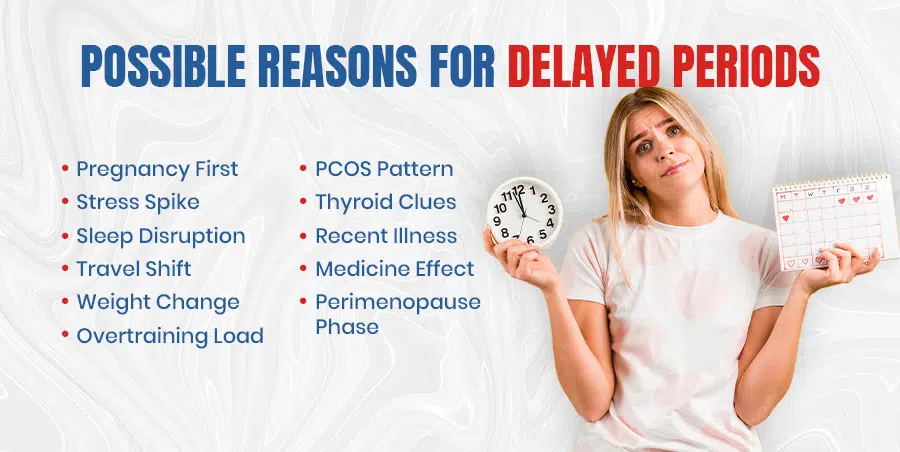
The most common delayed periods causes include pregnancy, stress, lifestyle changes, weight shifts, intense exercise, PCOS, thyroid imbalance, illness, medications, and age-related hormonal changes.
Top Causes Of Delayed Periods And What They Usually Mean
| Cause | What It Usually Means |
|---|---|
| Pregnancy | Always rule out first |
| Stress and Poor Sleep | Can delay ovulation |
| Travel or Night Shifts | Temporary hormone disruption |
| Rapid Weight Change | Can stop ovulation |
| Intense Exercise | Overtraining suppresses cycles |
| PCOS | Irregular cycles, acne, hair growth |
| Thyroid Imbalance | Fatigue, weight, hair changes |
| Recent Illness | Body pauses ovulation |
| Medications | Bleeding pattern may change |
| Perimenopause (40+) | Hormones fluctuate |
- Pregnancy: Check First – If pregnancy is possible, take a test after 7 days of missed period. First-morning urine gives better accuracy.
- Stress And Poor Sleep – Stress raises cortisol, which can delay ovulation. Poor sleep worsens hormonal imbalance.
- Weight Changes And Diet Shifts – Crash dieting, sudden weight loss, or rapid weight gain can disrupt hormone signals and delay ovulation.
- Travel, Routine Change, And Jet Lag – Sleep disruption and time zone changes can shift ovulation by days.
- Intense Exercise Or Overtraining – Heavy training combined with low calorie intake can delay or stop periods.
- Hormonal Conditions – PCOS: delayed periods, acne, excess facial/body hair. Thyroid problems: fatigue, hair fall, weight changes. High prolactin (less common): missed periods, headaches
- Illness Or Recent Infection – Fever or recovery can delay ovulation. Cycles often normalize in 1–2 months.
- Medications And Contraception – Hormonal contraception and emergency pills can temporarily alter cycle timing.
- Perimenopause – After 40, cycle changes are common. Heavy, frequent, or prolonged bleeding needs evaluation.
Delayed Periods Symptoms: What You May Notice
Delayed Periods Symptoms vary depending on the cause. Some people only notice a late date. Others may notice:
- breast tenderness or nausea
- acne or excess hair growth
- fatigue or hair fall
- pelvic pain or unusual discharge
Severe pain, fever, or foul-smelling discharge should never be ignored.
7 Safe Natural Ways To Support Your Cycle

These steps help when delays are caused by lifestyle factors. They support hormonal balance rather than forcing bleeding.
- Prioritise Sleep Consistency – Sleep and wake at similar times daily.
- Reduce Stress Gently – 10–15 minutes of walking, breathing, or stretching helps.
- Eat Enough And Eat Regularly – Avoid skipping meals. Include protein and healthy fats.
- Support Iron And Folate Through Food – Leafy greens, legumes, eggs, lean meats.
- Keep Exercise Moderate – If overtraining, reduce intensity temporarily.
- Stay Hydrated And Avoid Intake Spikes – Avoid sudden increases in caffeine or alcohol.
- Track Your Cycle For 2–3 Months – Note dates, flow, pain, mood, sleep.
Natural Methods And “Home Remedies” You Should Avoid
Avoid anything that claims to “force” a period. These can be unsafe, especially if pregnancy is possible.
| Myth | Reality |
|---|---|
| Herbs induce periods safely | Many are unsafe |
| Vitamin C forces bleeding | No proven benefit |
| Hormone pills are harmless | Can delay diagnosis |
| Forcing bleeding fixes cycles | Ovulation matters |
Avoid:
- strong herbal mixes,
- self-medicating hormones,
- crash diets or detox fasts,
- excessive heat therapies.
How Long Do Natural Steps Take To Help?
Lifestyle-related delays often improve within 2–8 weeks or the next 1–2 cycles. Stop self-care and seek medical help if:
- pain worsens,
- bleeding is heavy,
- dizziness or fainting occurs,
- pregnancy is suspected.
When Should You See A Gynecologist?
See a doctor if:
- delays repeat over 2–3 cycles,
- periods stop for 3 months (not pregnant),
- pain or bleeding is severe,
- PCOS or thyroid symptoms appear.
Delayed Periods Diagnosis At PSRI Hospital
Delayed Periods Diagnosis usually starts with a pregnancy test, followed by tests based on symptoms:
- hormone blood tests
- thyroid tests
- pelvic ultrasound
- additional tests if anemia or heavy bleeding is present
Evaluation is stepwise, focused on clarity and safety.
Book Your Appointment At PSRI Hospital, New Delhi
If your periods are delayed repeatedly, painful, or causing concern, early evaluation can prevent confusion and complications. Some delays resolve naturally, but ongoing irregularity needs proper assessment.
At PSRI Hospital, New Delhi, gynecology care focuses on clear diagnosis, ethical treatment, and patient comfort. Doctors review cycle history and symptoms carefully before recommending tests or treatment.
PSRI is a trusted multispeciality hospital new delhi residents rely on and is widely regarded as a best hospital in delhi for integrated women’s health care.
Call Us: +91 84848-48417, +91 11 6142 6142
Address: PSRI Hospital, Press Enclave Marg, Sheikh Sarai II, Near Saket Court, New Delhi – 110017.
Booking an appointment can help you get clarity, reassurance, and the right care at the right time.