Book An Appointment
 Virtual Consultation
World Thalassemia Day 2026: Awareness, Prevention & Management

FACT CHECKED
Your child looks pale for months, and even iron treatment is not helping. This is when families turn the conversation to thalassemia realising early screening before pregnancy could have prevented the problem.
Thalassemia is an inherited blood disorder, and thalassemia awareness helps families understand the symptoms early, choose the right screening tests, and plan treatment without any delay. And when prevention is not possible, good long-term care can help a child grow and live well.
PSRI Hospital, the NABH and NABL accredited multispeciality hospital in New Delhi, supports thalassemia care across screening, diagnosis, and ongoing management with specialist expertise. This blog by our experts explains what thalassemia is, the thalassemia symptoms, and how prevention, treatment and management options work.
What Is Thalassemia, And Why Does Awareness Still Matter In 2026?
Thalassemia is a genetic blood disorder where the body cannot make enough healthy haemoglobin; a protein in red blood cells that carries oxygen throughout the body.
Two parents who feel completely healthy can have a child with severe thalassemia, because both silently carry the gene with no signs at all.
In India, 3 to 4 in every 100 people carry this gene without knowing. When two carriers have a child, there is a 1 in 4 chance of thalassemia major . That is what thalassemia awareness prevents as just one test before marriage changes everything.
What Is World Thalassemia Day 2026? And Why Does It Matters In India?
World Thalassemia Day falls on 8th May every year. The 2026 theme is: “Hidden No More: Finding the Undiagnosed. Supporting the Unseen.”
That theme hits hard in India as thousands of carriers go undetected. High rates across states like Punjab, Gujarat, Maharashtra, West Bengal, and Delhi NCR, shows premarital screening still remains far from routine. If there is unexplained anemia in your family, you are planning marriage, or you are pregnant — get tested first.
Top 6 Thalassemia Symptoms In Babies, Children, And Adults
The thalassemia symptoms depend entirely on severity as a carrier feels nothing, while a child with thalassemia major shows clear signs within the first 2 years of life. In babies and young children, the common signs families notice are:
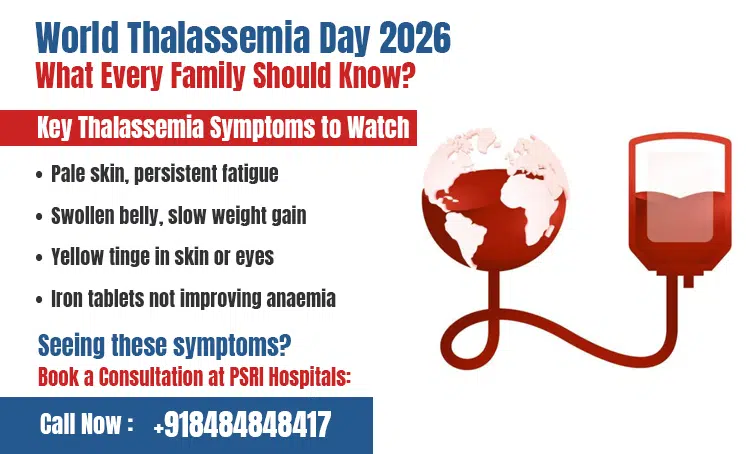
- Unusual paleness — skin, inner eyelids, lips washed out
- Constant tiredness and weak feeding
- Slow growth — not gaining weight as expected
- Swollen belly — liver and spleen enlarging
- Yellow tinge in skin or eyes
- Prominent forehead or cheekbones in untreated cases
In adults with thalassemia minor, mild fatigue and persistently low haemoglobin are the most common thalassemia symptoms . Many carry this for decades undiagnosed.
What Is The Difference Between Alpha And Beta Thalassemia?
The difference between alpha and beta thalassemia is based on which part of the blood’s haemoglobin is affected. Alpha thalassemia affects the alpha chain of haemoglobin whereas beta thalassemia affects the beta chain.
In India, beta thalassemia is more common, serious, and is more likely to cause symptoms that need regular treatment.
| Feature | Alpha Thalassemia | Beta Thalassemia |
|---|---|---|
| Gene affected | Alpha-globin (chromosome 16) | Beta-globin (chromosome 11) |
| Severity | Silent carrier to severe | Minor (carrier) to major |
| Common in India? | Less common | Very common |
| Diagnosis age | At birth or prenatally | Within first 1–2 years |
| Needs transfusions? | Only severe forms | Always, in thalassemia major |
| Curable by BMT? | Yes (severe forms) | Yes |
How Does Thalassemia Prevention Work?
Thalassemia prevention involves carrier screening before marriage, followed by prenatal diagnosis if both partners are confirmed carriers.
Who Should Get Screened?
Anyone planning marriage or a family with unexplained anaemia or a blood count showing small red blood cells should get screened.
Which Tests Are Used Before Marriage Or Pregnancy?
Tests used before marriage or pregnancy to inquire about thalassemia includes:
- CBC to spot the pattern
- Haemoglobin Electrophoresis (HPLC) to confirm carrier status
- DNA testing to identify the mutation when needed.
When Is Prenatal Diagnosis Done?
If both partners are carriers and a pregnancy is underway, CVS between 11 to 14 weeks , amniocentesis around 16 to 20 weeks are performed. Both confirm whether the baby has thalassemia major or not.
What Are The Main Thalassemia Management Options Today?
Managing thalassemia major comes down to four things: regular blood transfusions, iron chelation therapy, routine heart and liver monitoring, and bone marrow transplant for eligible patients.
How Does Bone Marrow Transplant Help In Severe Thalassemia?
A bone marrow transplant replaces the faulty bone marrow with healthy donor stem cells, so the body starts making normal haemoglobin on its own. When it works, the disease is cured.
Best outcomes happen in younger children before age 7 to 10 with a matched sibling donor and minimal organ damage. For families asking about the best hospital in Delhi for thalassemia BMT , the experience before, during, and after the transplant is what shapes the result.
Why Does Community Awareness Matter In The Fight Against Thalassemia?
Thalassemia cannot be stopped by medicine alone. Communities need to talk, test, and stop treating a carrier result like something shameful. Stigma is the biggest barrier. Families avoid testing fearing it will affect marriage prospects and that silence is how the disease carries forward.
Cyprus and Iran brought thalassemia major births close to zero through routine premarital screening. Thalassemia awareness at community level is what changes the numbers — and World Thalassemia Day 2026 is a push for exactly that.
Book A Hematology Consultation At PSRI, A Multispeciality Hospital New Delhi
PSRI Hospital, the best hospital in Delhi, supports full thalassemia care pathway, including carrier screening, prenatal diagnosis, transfusion and chelation management, and bone marrow transplant support. It also has a dedicated blood bank running 24/7, which is important for families managing long-term blood disorders.
If your child looks pale and is not improving with iron, if you are planning a pregnancy, or if a thalassemia diagnosis has just come into your family, do not sit with the confusion alone. Get the right answers early. Book your appointment now at PSRI, multispeciality hospital New delhi. Call: +91 84 84 84 84 17
Frequently Asked Questions (FAQs)
Q: Can thalassemia be fully cured?
Yes, a bone marrow transplant is a permanent cure for thalassemia major. It works best in younger age children when a matched sibling donor is available.
Q: Will I develop thalassemia if I am just a carrier?
No, carriers live completely normal lives. The risk is to their child if the partner is also a carrier, thus prior testing before marriage matters.
Q: When should a child be tested?
A child should be tested as early as possible if there is unexplained anemia in the family.
Q: What test confirms thalassemia?
Haemoglobin Electrophoresis (HPLC) alongside a CBC and genetic testing identifies the specific mutation when both partners are carriers.
Q: How often does a thalassemia major child need transfusions?
Every 3 to 4 weeks, targeting haemoglobin above 9 to 10 g/dL between each transfusion.