Book An Appointment
 Virtual Consultation

International Patient Guide: Treatment in India

FACT CHECKED
You have a diagnosis. You’ve chosen India for treatment. You know the hospital. Now you don’t know what comes next.
That gap between deciding and doing is where most international patients feel the most anxious. You’re planning a medical journey in a country you may never have visited. You’re doing it while already unwell, or while supporting someone who is.
In 2025, 507,244 foreign nationals travelled to India specifically for medical treatment. Most of them used an international patient guide like this one to navigate the process. Most had the same questions you have right now. This guide answers them. In order. Step by step, from your first contact with the hospital to the day you fly home.
Before You Travel: How to Start the Medical Treatment Process in India?
Most patients make the mistake of booking flights before they have a confirmed treatment plan. Don’t do that. The process has a specific sequence. Each step depends on the one before it.
Step 1: Share Your Medical Records
Send your diagnosis, recent test reports, imaging (X-rays, MRI, CT scans) and current medication list to the hospital’s international patient services team. Send them digitally. Keep physical copies too.
The team reviews your case and routes it to the right specialist. At PSRI Hospital, our international patient services team reviews your records and connects you with the relevant department. You hear back within a defined response window. You don’t need to guess which doctor to contact.
Step 2: Receive Your Treatment Plan and Cost Estimate
Based on your records, the treating specialist prepares a preliminary treatment plan. You receive a written cost estimate covering the procedure, hospital stay, tests and basic post-operative care.
Read this carefully. Ask what’s included. Ask what’s not. Ask whether the estimate covers complications that may arise during or after the procedure. A clear answer here prevents surprises later.
Step 3: Ask the Questions That Matter Before You Commit
Most patients don’t ask enough before they agree to travel. These questions protect you:
- How many times has this surgeon performed this specific procedure?
- What is the expected hospital stay and recovery timeline?
- What happens if the diagnosis changes after I arrive and have in-person tests?
- Is the cost estimate fixed or can it change?
- What follow-up do I get after I return home?
- Who is my point of contact if something goes wrong after discharge?
A hospital that answers these clearly is a hospital worth trusting.
Step 4: Get Your Visa Invitation Letter
Once you confirm the treatment plan, the hospital issues a formal invitation letter for your medical visa application. This letter names the hospital, the treating doctor, the procedure and the expected dates of treatment.
At PSRI Hospital, our team issues the visa invitation letter as part of our standard support for international patients. We send it to you and, where required, directly to the embassy.
Step 5: Apply for Your E-Medical Visa
India’s e-Medical Visa allows a 60-day stay with triple entry. One companion can travel on a concurrent medical attendant visa. Apply through the Indian government’s official visa portal. Processing takes 3 to 7 working days in most countries. Apply at least 4 to 6 weeks before travel. Allow room for delays.
Step 6: Book Your Flights After Visa Confirmation
Never book non-refundable flights before the visa is confirmed. Once you have the visa, confirm your admission date with the hospital and book travel accordingly.
What to Pack and Carry for Medical Treatment in India?
Packing for a medical trip is different from packing for travel. Forget what you don’t need. Bring everything the hospital and your recovery will require.
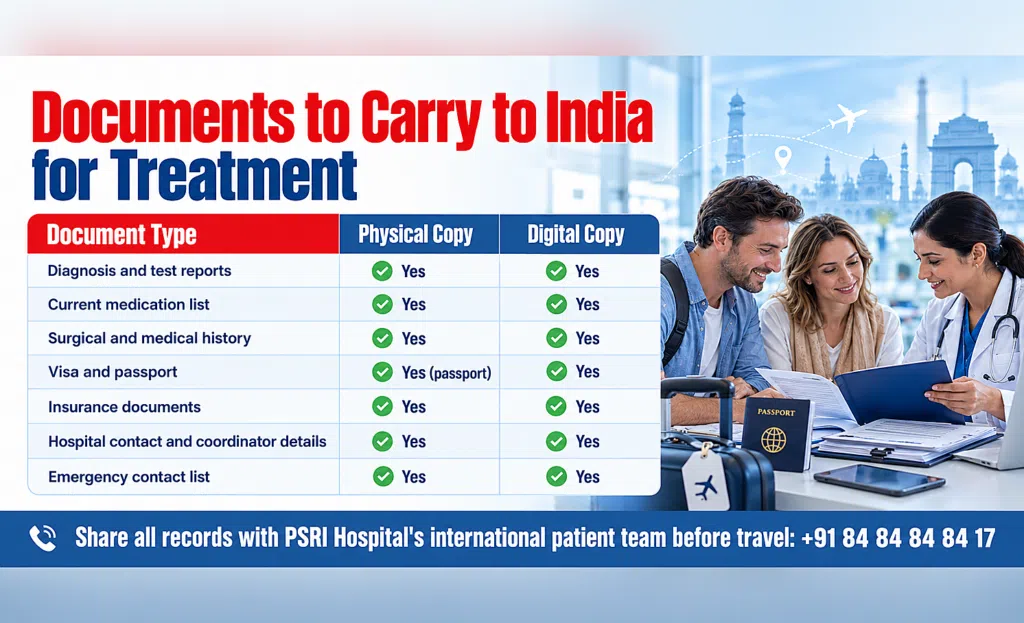
Medical Documents to Carry (Physical and Digital):
- All diagnosis reports, blood tests, imaging and biopsy results
- Current medication list with generic names, not just brand names
- List of known allergies and previous surgical history
- Vaccination records if relevant to your treatment
- Travel and health insurance documents
- Your visa and passport (carry a digital copy separately)
Personal Items for a Long Recovery Stay:
- Loose, comfortable clothing that accommodates post-surgical dressings
- Warm layers for December to February evenings
- Power bank and universal adapter
- A working local SIM card (buy one at IGI Airport on arrival)
- Sufficient supply of your regular medications with prescription documentation
What Your Companion Needs to Carry:
Your companion carries more responsibility than most people realise. They handle logistics while you focus on recovery. They need:
- Their own visa and travel documents
- A list of emergency contact numbers including the hospital coordinator
- Sufficient local currency for the first few days (ATMs are accessible near PSRI Hospital)
- A mobile phone with the hospital’s WhatsApp number saved
When You Arrive in Delhi: What to Expect at the Hospital?
Delhi’s Indira Gandhi International Airport connects to South Delhi in approximately 20 to 25 minutes via the Airport Express Metro. If your hospital has arranged a transport pickup, your coordinator meets you at the arrival terminal with your name displayed.
At PSRI Hospital, Here Is What Happens on Arrival:
Your coordinator meets you at the hospital entrance. They handle registration, room allocation and all documentation. You don’t queue or navigate forms alone.
Your treating doctor schedules a first consultation within 24 hours of admission in most cases. This consultation matters. The doctor reviews your records in person, examines you directly and confirms the treatment plan.
One Thing Most Hospitals Don’t Tell You: The treatment plan sometimes changes after this first in-person consultation. A scan ordered in India may show something the earlier reports didn’t capture. The surgery may need to be modified. The timeline may shift.
This isn’t a problem. It’s the system working correctly. An honest hospital tells you what they found. They adjust the plan before proceeding. Ask your coordinator to explain any changes in full before you agree to proceed.
What to Expect During Your Treatment and Hospital Stay?
Once treatment begins, your job is to focus on getting better. Everything else, the schedule, the tests, the logistics, your coordinator manages. Here’s what the hospital days actually look like.
Your Daily Routine in the Ward:
Nursing rounds happen at fixed intervals. The treating doctor visits once or twice daily depending on your condition. Tests, scans and procedures get scheduled by the ward team and your coordinator communicates the schedule to you and your companion.
Communicating With the Medical Team:
Don’t wait for the doctor’s round to raise a concern. Every ward has a nursing station. Your coordinator is your direct line for non-urgent questions. For urgent concerns, the nursing staff escalates immediately.
If you need an interpreter at any point, ask your coordinator. At PSRI Hospital, we arrange interpreter support where required so that neither you nor your companion struggles with language during critical conversations.
Managing Your Companion’s Needs:
Your companion can stay in the room with you in most cases. They need food, rest and emotional support too. The hospital’s cafeteria, nearby restaurants and pharmacy are accessible. Your coordinator helps with anything beyond the ward.
When Something Doesn’t Feel Right:
Tell someone. Don’t assume a new symptom is normal. Don’t wait until the doctor’s scheduled visit if something feels urgent. The nursing team assesses and escalates. Use them.
What Happens at Discharge: How to Leave India Ready for Recovery?
Discharge isn’t the end of treatment. It’s the transition point between hospital care and self-managed recovery. How well you manage this transition affects how well you heal at home.
Your Discharge Summary:
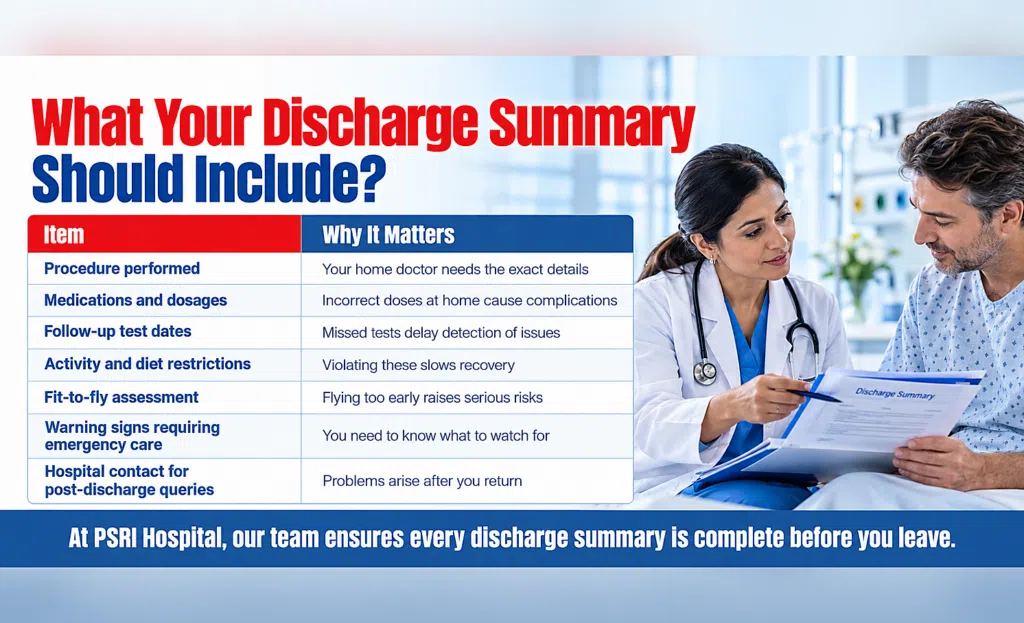
Every international patient receives a written discharge summary. Read it before you leave. It should contain:
- Confirmed diagnosis and procedure performed
- Medications prescribed, with dosages and duration
- Follow-up tests required and when to do them
- Restrictions on activity, diet and travel
- Warning signs that need immediate medical attention
- Contact details for post-discharge queries
Fit-to-Fly Clearance:
Many procedures require a waiting period before you can fly safely. Air pressure changes in aircraft affect post-surgical healing. Clot risk rises on long flights after many procedures. Your treating doctor assesses whether you’re medically cleared to fly. They specify what flight duration is safe.
Ask for this assessment explicitly before booking your return flight. Don’t assume clearance. Get it confirmed in writing in your discharge summary.
Before You Leave Delhi:
- Collect all your original reports and imaging
- Confirm your post-discharge teleconsultation date with the hospital
- Fill prescriptions before leaving India if the medications aren’t available in your home country
- Get a customs declaration letter from the hospital if you’re carrying injectable medications
After You Return Home: Recovery, Follow-Up and Staying Connected
Most complications don’t announce themselves in hospital. They appear weeks after discharge. At home. In a different country. Without your treating team nearby.
Post-Discharge Teleconsultation:
Schedule a teleconsultation with your treating doctor for 1 to 2 weeks after returning home. At PSRI Hospital, we provide post-discharge follow-up via teleconsultation as part of our international patient support. Our team handles the scheduling before you leave.
Sharing Records With Your Home Doctor:
Give your discharge summary to your local doctor within a week of returning. They need to know exactly what was done, what medications you’re on and what warning signs to watch for. Don’t let that handover slip.
Warning Signs to Watch for After Return:
Call your treating doctor or go to an emergency facility if you notice:
- Fever above 38°C appearing after discharge
- Increasing pain or swelling at the surgical site
- Redness, warmth or discharge from the wound
- Breathlessness or chest pain after a procedure involving the chest or heart
- Jaundice, dark urine or swelling in the abdomen after liver or abdominal surgery
- Any symptom that appeared suddenly and doesn’t match what your discharge summary described
What If You Need to Come Back?
Some conditions require a second phase of treatment, a procedure that must happen after initial healing or a complication that needs in-person assessment. Your coordinator at PSRI Hospital remains your contact point for this. We help you plan a return visit when needed, applying the same process from the beginning.
Questions Every International Patient Should Ask Before Committing to Treatment
This is the list most patients wish they had seen before they started. Ask these before you confirm the treatment plan and book flights.
About the Doctor:
- How many procedures of this specific type do you perform per year?
- Will you personally perform the surgery or will a team member?
- Who is responsible for my care if you are unavailable?
About the Procedure:
- What are the realistic risks and what happens if a complication arises?
- What will my physical state be immediately after the procedure?
- How long before I can walk, travel and resume normal activity?
About Costs:
- What does the estimate include and what does it exclude?
- What triggers additional costs and how are they communicated?
- Do you accept international health insurance?
About Recovery and Follow-Up:
- How do I get medical support after I return home?
- Will you coordinate with my doctor in my home country?
- Who do I contact if a problem arises 3 months after I return?
How PSRI Hospital Supports International Patients Through Every Stage?
At PSRI Hospital, we have supported international patients from over 40 countries since 1996. We know that coming to India for treatment involves trust. In the doctors, in the process, in the team. As a multispeciality hospital in Delhi that has served international patients for nearly three decades, we take that trust seriously.
Here’s how we support you at every stage:
Before You Travel:
- Free teleconsultation with the relevant specialist before you book flights
- Written treatment plan and cost estimate based on your medical records
- Visa invitation letter issued promptly after treatment confirmation
- Appointment scheduling and pre-admission coordination
When You Arrive:
- Coordinator present for registration, admission and room allocation
- Interpreter support arranged where required
- Companion assistance with local logistics
During Your Treatment:
- Dedicated coordinator as your single point of contact throughout your stay
- Regular family updates on your progress
- Second opinion from additional specialists within the hospital if needed
- Transparent communication from the medical team at every step
At Discharge and After:
- Complete discharge summary reviewed with you before you leave
- Fit-to-fly assessment included in discharge
- Post-discharge teleconsultation scheduled before you depart
- Query support after you return home
Specialties We Treat Most Frequently for International Patients:
Liver transplant and hepatology, cardiac sciences, kidney transplant and renal sciences, neurosciences, orthopaedics and joint replacement, oncology and gastroenterology.
Where We Are:
PSRI Hospital sits at Sheikh Sarai II, near Saket Court, New Delhi. We’re a NABH and NABL accredited multispeciality hospital in Delhi with over 35 specialties. As a multispeciality hospital New Delhi, we’re one of the most accessible options for international patients flying into IGI Airport. Patients searching for a multispeciality hospital near me in South Delhi find us close to IGI Airport, Sheikh Sarai Metro and the Saket area, accessible from Malviya Nagar, Panchsheel Park and Greater Kailash.
Ready to Start?
We’re recognised as the best hospital in New Delhi for specialist tertiary care across the treatments international patients most commonly need. As one of the most established multispeciality hospitals New Delhi has, we’ve refined this process across 40-plus countries.
If you’re ready to start, call us. If you’re still deciding, call us anyway. We’ll help you understand your case, explain what treatment looks like here and tell you what the process feels like for someone in your position.
Call +91 84 84 84 84 17 to reach our international patient services team at PSRI Hospital, Press Enclave Marg, Sheikh Sarai II, near Saket Court, New Delhi 110017.
Frequently Asked Questions
How do I start the process of getting treatment at a hospital in India?
Send your diagnosis reports and test results to the hospital’s international patient team. They review your case, connect you with the right specialist and send a treatment plan with a cost estimate before you commit to anything.
Do I need someone to accompany me for treatment in India?
One companion is strongly recommended, especially for major surgery or transplant. India’s medical visa allows one attendant visa. Your companion handles logistics, supports recovery and communicates with the hospital when you cannot.
How soon can I fly home after surgery in India?
It depends on the procedure. Most surgeries require 10 to 21 days before flying is safe. Your treating doctor issues a fit-to-fly assessment before discharge. Get this in writing before booking your return flight.
What if my treatment plan changes after I arrive?
It sometimes does, and that’s normal. In-person examination and local tests occasionally reveal details the earlier reports didn’t show. An honest hospital explains the changes clearly before proceeding. Ask your coordinator to walk you through any revision.
Does PSRI Hospital provide follow-up after I return home?
Yes. We schedule a post-discharge teleconsultation before you leave, connect you with our international patient team for ongoing queries and coordinate with your home doctor on request. Our support doesn’t end at the airport.