Book An Appointment
 Virtual Consultation
HPB Surgery vs Liver Transplant: Importance, Signs & Conditions

FACT CHECKED
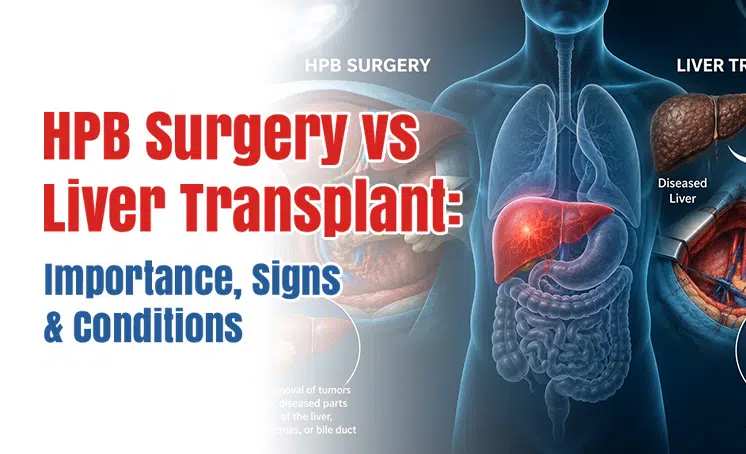
The liver is one of the few organs that can heal itself. But there’s a point where that healing stops. Past that point, transplant becomes the only real option.
HPB surgery and liver transplant are not the same treatment. HPB surgery removes a tumour, clears a blockage, or repairs a bile duct while the liver keeps functioning. Liver transplant replaces a liver. Which one applies to you depends on how much of the liver is still working.
At PSRI Hospital, Delhi, Dr. Manoj Gupta leads liver transplant and HPB surgery with over 1,200 transplants performed since 1996. We are NABH and NABL accredited, with a dedicated liver board that reviews every case before a path is recommended.
This blog covers the HPB surgery vs liver transplant importance, conditions each procedure treats, the warning signs and exactly how doctors decide between them.
What Is HPB Surgery and Which Liver Conditions Does It Treat?
HPB stands for Hepato-Pancreato-Biliary. The HPB surgery removes disease from the liver or the organs around it while keeping the liver in place. The liver stays, keeps working. And only the problem gets taken out.
The most common reason patients come to us and get HPB surgery done is liver cancer caught early. When the cancer starts in the liver cells and the rest of the liver is still healthy, the tumour can be removed. No donor or transplant is needed.
Categories that fall under HPB surgery.:
- Gallbladder cancer
- Recurring gallstones
- And pancreatic tumours
- Bile duct problems are also treated here.
The bile duct is the tube that carries digestive fluid from the liver to the intestine. When it narrows or blocks, bile backs up into the liver and causes jaundice and pain. Surgery opens it or removes the affected section.
Signs That Point Toward Getting An HPB Assessment:
- Persistent pain on the upper right side of the abdomen
- Gradual yellowing of the skin or eyes
- Unexplained weight loss with no diet change
- A lump or fullness felt in the upper abdomen
- Pale stools or very dark urine
None of these confirm a diagnosis. Each one is reason enough to stop waiting and get imaging done.
At PSRI, most HPB procedures are done using keyhole surgery (small cuts, a camera, faster recovery than open surgery). Robotic-assisted HPB surgery is also available under the best liver specialist in India.
What Is a Liver Transplant and When Is the Liver Beyond Repair?
The liver is the only organ in the body that regenerates. When it’s diseased but still partially working, treatment can help it recover. When it fails entirely, a transplant with a healthy one from a donor becomes the only option. It’s the right treatment when the liver can no longer filter blood, make clotting proteins, or support digestion.
- The most common reason for liver transplant is cirrhosis. Years of liver damage from alcohol, hepatitis B or C, fatty liver disease, or autoimmune conditions leave the liver with permanent scarring and the whole organ fails.
- Acute liver failure is a different kind of emergency. The liver collapses fast, sometimes in someone who had no previous liver problem at all. These patients need transplant evaluation the same day.
- End-stage liver disease and inherited liver conditions in children are the other main pathways to transplant. Biliary atresia (when bile ducts are absent from birth) is one example.
Signs The Liver Is In Serious Trouble:
These don’t appear one at a time. When several like jaundice, ascites etc. show up together, liver is losing the battle:
- Skin and eyes turning yellow: The liver can’t process bilirubin (a pigment from old blood cells) so it builds up in the skin.
- Abdomen swelling with fluid(ascites): The liver can’t make enough protein to hold fluid inside blood vessels, so it leaks into the belly.
- Confusion or sudden memory lapses
- Very dark urine and pale or clay-coloured stools
- Bruising easily or cuts that bleed longer
- Bone-deep tiredness that sleep doesn’t fix
Three or more of these together need same-day assessment at a best liver transplant centre in Delhi.
How Do Doctors Choose Between HPB Surgery and Liver Transplant for the Same Patient?
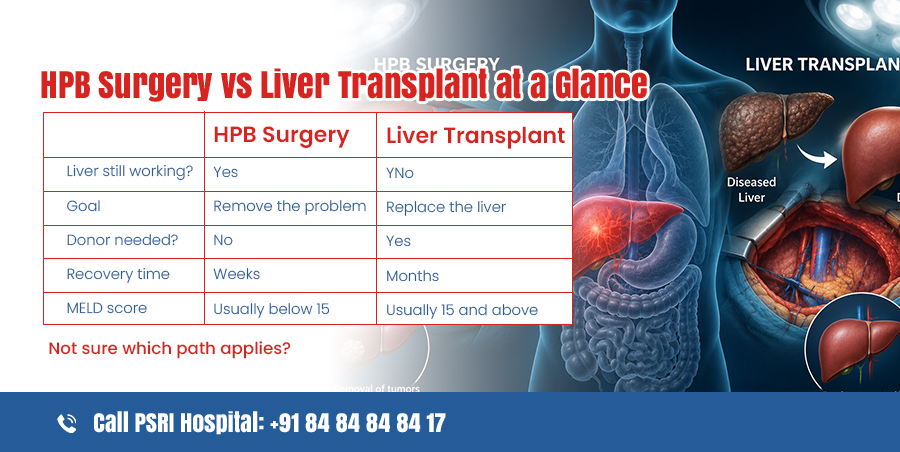
The same diagnosis in two different patients can lead to completely different recommendations. It isn’t about which surgery the doctor prefers. It’s about how much liver function is still left, calculated through MELD score. Model for End-Stage Liver Disease is a number from 6 to 40 where a higher number means the liver is failing faster and transplant becomes more urgent.
- Below 15: the liver is managing. HPB surgery or medication is usually the path.
- 15 to 25: transplant is being considered. The patient starts the formal evaluation.
- Above 25: transplant is urgent. Operating on the liver alone won’t restore its function.
Alongside the MELD score, imaging fills in the rest. A CT or MRI scan by the best liver specialist in Delhi NCR shows whether the disease sits in one removable spot, or whether it’s spread through the liver in a way surgery can’t fix.
Get the Right Liver Assessment at PSRI Hospital, Delhi
If a liver diagnosis has been made and you’re still trying to understand what it means, one proper assessment cuts through more uncertainty than months of reading.
PSRI Hospital has the best liver specialist in India, transplant surgeons, hepatologists, and HPB surgeons reviewing the same case together. We are one of the top 10 hospital in Delhi, with NABH and NABL accreditation, Fibroscan, CT/MRI, PET-CT, and 24/7 critical care for transplant patients.
“The decision between HPB surgery and liver transplant is never obvious from the outside. It comes from looking at the whole picture: the blood work, the imaging, the liver’s reserve, the patient’s overall condition. That’s a decision the team makes together.” – Dr. Manoj Gupta, Chief Consultant, Liver Transplant and Surgical Gastroenterology, PSRI Hospital Delhi
To speak with a liver transplant surgeon in Delhi, call +91 84 84 84 84 17.
Frequently Asked Questions
What Does HPB Surgery Mean in Simple Terms?
HPB stands for Hepato-Pancreato-Biliary. It’s surgery on the liver, bile ducts, gallbladder, or pancreas. Used when the liver is still working but has a disease or blockage that needs removing.
What Conditions Require a Liver Transplant?
Cirrhosis, acute liver failure, end-stage liver disease, certain liver cancers meeting transplant criteria, and inherited liver conditions in children. In all of these, the liver can no longer recover through surgery or medication alone.
How Do Doctors Decide Between HPB Surgery and Liver Transplant?
Mainly through the MELD score (calculated from blood tests) and imaging that shows whether the disease is in one removable area or spread throughout the liver. A MELD score below 15 usually points toward HPB surgery. Between 15 and 25, transplant evaluation begins.
Can Liver Cancer Be Treated With Surgery Instead of a Transplant?
Yes, when it’s caught early and the rest of the liver is healthy. HPB surgery removes the tumour. If the liver also has cirrhosis, or the tumour meets Milan Criteria, transplant removes both the cancer and the damaged liver in one procedure. That’s the better option.
What Is a MELD Score and Why Does It Matter?
It’s a number from 6 to 40 based on three blood tests. Low means the liver is coping. Above 25 means it’s in serious danger and transplant is urgent. It’s the clearest way doctors measure liver severity and it directly shapes the HPB vs transplant decision.