Book An Appointment
 Virtual Consultation

Best Time to Travel to India for Medical Treatment

FACT CHECKED
You’ve decided to come to India for treatment. You’ve found a hospital. The next question is when.
The timing matters more than most people think.
- Come in May and you’re recovering from surgery in 44-degree Delhi heat.
- Come in August and you’re navigating monsoon rains that flood streets and delay travel.
- Come between October and March and the weather works with your recovery, not against it.
That’s the difference.
In 2025, 507,244 foreign nationals travelled specifically for medical treatment in India, making up approximately 5.5% of all foreign tourist arrivals. Most of them chose the cooler months for good reason.
India’s medical tourism market reached $8.7 billion in 2025. India now ranks third globally as a medical tourism destination. The market is projected to reach $16.2 billion by 2030.
This guide about Best Time to Travel to India for Medical Treatment covers when to travel, which months to avoid and how timing affects different treatments. It also covers what to plan before arriving.
Why October to March Is the Best Time to Travel to India for Medical Treatment?
The October to March window gives international patients the most comfortable conditions for travel, treatment and recovery.
Delhi in October to November sits between 18 and 32 degrees Celsius. Humidity is low. Air quality, while variable, is more manageable than in summer. Patients recovering from surgery can move around without heat stress on the body. Companions can navigate the city comfortably.
December to February is the peak sweet spot. Temperatures range from 10 to 22 degrees. These are the coolest months, and cooler conditions help post-operative healing. Breathing is easier. Sleep is better. Wound healing goes more smoothly without sweat and heat.
March extends the comfortable window. Temperatures start rising toward the end of the month but remain manageable for most of the month.
| Month | Delhi Temperature | Recovery Comfort | Notes |
|---|---|---|---|
| October | 18 to 32°C | Good | Post-monsoon, low humidity |
| November | 13 to 28°C | Very Good | Comfortable, clear weather |
| December | 10 to 20°C | Excellent | Peak season, cool and dry |
| January | 8 to 18°C | Excellent | Coldest month, good for recovery |
| February | 10 to 22°C | Excellent | Ideal, comfortable |
| March | 16 to 30°C | Good | Rising heat toward month-end |
Which Months to Avoid and Why?
Not every month works equally well for medical travel to Delhi. Some months create real practical problems for patients in recovery.
April to June: Peak Summer
Delhi summer hits hard. April starts manageable, but May and June regularly cross 42 to 46 degrees Celsius. That heat adds cardiovascular stress, increases fluid loss and disrupts sleep for patients recovering from cardiac surgery, liver transplant or joint replacement. Air-conditioning helps indoors. But short outdoor movement between ward, diagnostic lab and accommodation still becomes physically demanding. If surgery can wait, these months shouldn’t be your first choice.
July to September: Monsoon
The monsoon brings relief from the heat but creates different problems. Parts of Delhi flood after heavy rain. Roads become unpredictable. Outdoor movement becomes complicated for patients with limited mobility. Post-surgical wound care requires careful management in high humidity. Infection risk from environmental factors rises. That doesn’t mean the monsoon is impossible for medical travel, but it adds logistical complexity that patients should plan for consciously.
What If Your Treatment Can’t Wait?
Some conditions don’t allow you to schedule by season. A cancer diagnosis, acute organ failure or a rapidly progressing condition needs treatment when it needs treatment. In those cases, the hospital and your dedicated coordinator help you manage the seasonal challenges. Air-conditioned transport, climate-controlled wards and planned movement between hospital and accommodation reduce the seasonal impact significantly.
Does the Treatment Type Change the Best Time?
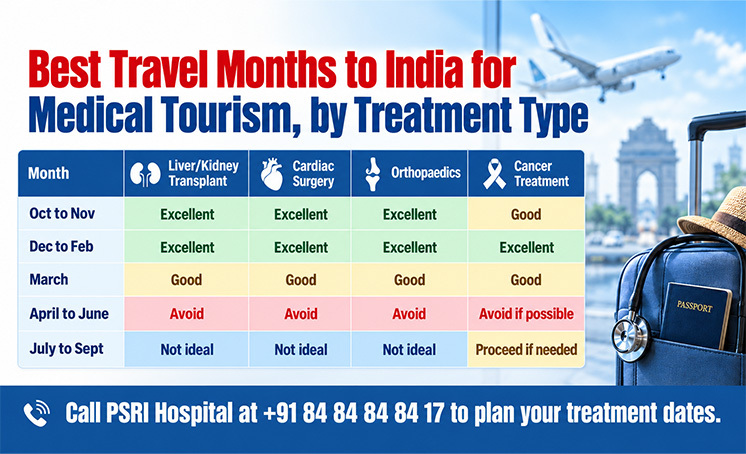
Yes, it does. Different treatments have different recovery needs, and those needs interact with the season.
- Liver Transplant and Kidney Transplant: October to March strongly preferred. Lower infection risk from environmental factors. Cooler conditions support the physical stress of major surgery. Post-transplant patients need daily blood tests and clinic visits for weeks. Doing that in December is easier than doing it in June.
- Cardiac Surgery and Cardiac Procedures: The cooler months reduce cardiovascular strain during recovery. Heat forces the heart to work harder even at rest. Post-bypass and post-valve patients do better without ambient heat adding to cardiac load.
- Orthopaedic Surgery and Joint Replacement: October to March is ideal. Physiotherapy starts days after surgery. Walking outdoors, building range of motion and gaining strength happen faster when the weather supports movement. A knee replacement patient doing outdoor walks in 42-degree heat faces a barrier that simply doesn’t exist in January.
- Cancer Treatment (Chemotherapy and Radiation): Cancer treatment cycles don’t always align with preferred travel windows, and that’s acceptable. If you have flexibility on when to start, beginning chemotherapy in October rather than June helps. Your body gets better recovery conditions between cycles.
- Gastroenterology, Hepatology and Digestive Disease: Year-round manageable, but October to March reduces the food safety risks that come with summer heat. Dietary compliance during recovery is easier in cooler months.
| Treatment | Best Window | Avoid |
|---|---|---|
| Liver transplant | October to February | May to August |
| Kidney transplant | October to February | May to August |
| Cardiac surgery | November to February | May to June |
| Joint replacement and orthopaedics | October to March | June to August |
| Cancer treatment | October to March if possible | May to June if avoidable |
| Gastroenterology | October to March | May to June |
What International Patients Need to Know About the Medical Visa?
India’s e-Medical Visa process is straightforward, but timing matters. Don’t leave it to the last week before travel.
The e-Medical Visa:
- Available to nationals of most countries at Indian embassies and online
- Valid for 60 days per visit, with triple entry allowed
- Covers one medical attendant (companion visa available for one accompanying person)
- Issued for specific treatment at a named hospital
What You Need to Apply:
- Invitation or treatment letter from the hospital
- Details of the treating doctor and department
- Proof of appointment or admission confirmation
- Recent passport-size photographs and valid passport
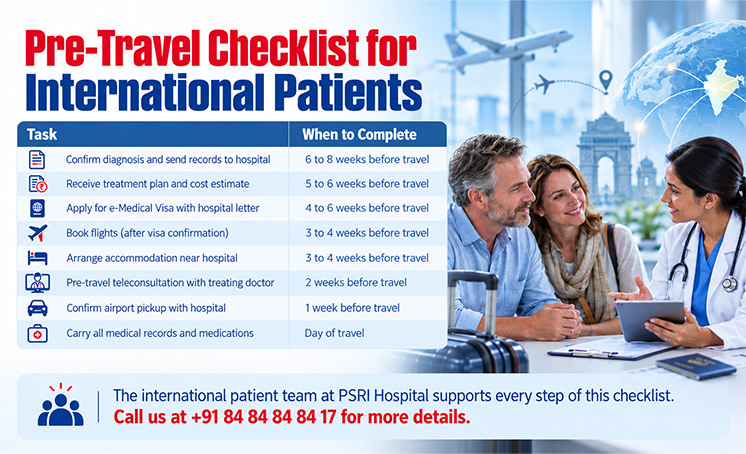
Timing: Apply at least 4 to 6 weeks before your planned arrival date. Processing times vary by country and embassy. Don’t book non-refundable flights until the visa is confirmed. That’s a mistake that’s hard to undo.
PSRI Hospital’s international patient services team issues the hospital invitation letter and treatment confirmation required for the medical visa application. That’s part of the support the team provides from the moment you first get in touch.
What to Plan for a Long Recovery Stay in Delhi?
Most international patients underestimate what a 3 to 6 week stay in Delhi actually needs. Here’s what matters.
Accommodation:
PSRI Hospital sits at Sheikh Sarai II, near Saket Court in South Delhi. Several service apartments and guesthouses operate within 2 to 5 kilometres. The international patient services team at PSRI can guide you toward accommodation options that suit your budget and mobility level.
Transport From IGI Airport:
Indira Gandhi International Airport connects directly to South Delhi via the Airport Express Metro Line. The journey takes approximately 20 to 25 minutes to New Delhi station, followed by a short cab ride to Sheikh Sarai. Pre-arranged hospital transport removes the stress. You don’t want to navigate an unfamiliar city right after a long flight.
Practical Packing for a Delhi Medical Stay:
- Warm layers for December to February nights, even if your home country is tropical
- Comfortable, loose clothing that accommodates bandages, drains or catheters if relevant
- Copies of all medical records, scan reports and test results in both physical and digital form
- A sufficient supply of any regular medication you take, with prescription documentation
Food During Recovery:
Delhi offers a wide range of dietary options, including halal food, South Indian, South-East Asian and Western food. Hospital dietary teams manage in-patient meals. For companions and outpatient recovery periods, the surrounding area offers choices for most dietary requirements.
What Makes Delhi the Right City for Medical Treatment in India?
International patients choose Delhi for practical reasons, not just reputation.
- Direct flights connect IGI Airport to the Middle East, East Africa, Southeast Asia, Central Asia, Europe and North America. PSRI Hospital’s international patients travel from Bangladesh, Afghanistan, Iraq, Uzbekistan, Kenya, Nigeria, Tanzania, Nepal, Sri Lanka and the Gulf states.
- South Delhi, where PSRI Hospital sits, concentrates several of India’s leading tertiary care hospitals within a small radius.
- For patients searching for a multispeciality hospital in Delhi with full specialist coverage, this area offers the densest concentration of options.
- Patients who need second opinions or inter-hospital coordination find plenty of choices nearby.
- The Sheikh Sarai area is well-connected by metro, road and taxi services.
- Delhi has a large community of expatriates and international visitors.
- Food, communication and daily logistics are manageable even if you don’t speak Hindi.
How PSRI Hospital Supports International Patients?
PSRI Hospital, a trusted multispeciality hospital in Delhi, has supported international patients from over 40 countries since 1996. It’s one of the most established multispeciality hospitals in New Delhi.
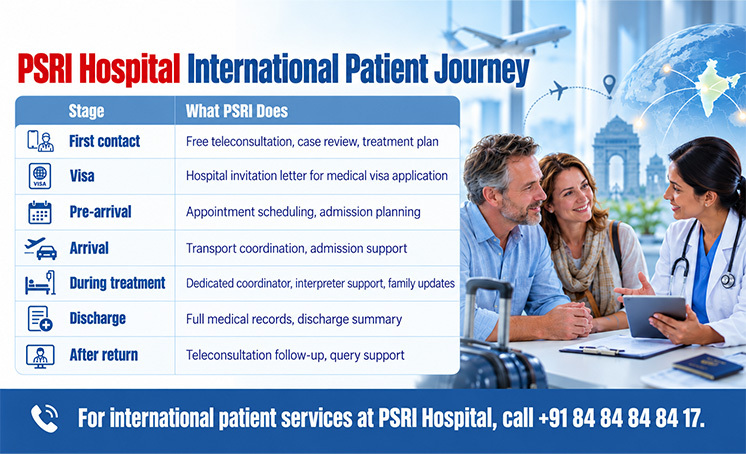
The international patient services team at PSRI Hospital coordinates every aspect of the treatment journey. Here’s what they handle:
Before You Travel:
- Free teleconsultation with the relevant specialist to review your case before you book flights
- Treatment plan and cost estimate based on your medical records
- Hospital invitation letter for your medical visa application
- Appointment scheduling and pre-admission planning
When You Arrive:
- Coordination of airport transfer arrangements
- Admission support and documentation
- Dedicated coordinator who stays your single point of contact throughout the stay
During treatment:
- Interpreter assistance where required
- Communication with your family in your home country
- Second opinion from additional specialists within the hospital if needed
After discharge:
- Discharge summary and full medical record for your home country doctor
- Post-discharge follow-up via teleconsultation
- Support with medical queries after you return home
International patients access PSRI Hospital’s specialties in this order of demand: liver transplant and hepatology, cardiac sciences, kidney transplant and renal sciences, neurosciences, orthopaedics and joint replacement, oncology and gastroenterology. Every specialty sits under one roof. That’s why patients from across the world choose this multispeciality hospital near me in South Delhi.
PSRI is a NABH and NABL accredited multispeciality hospital New Delhi with over 35 specialties. We bring tertiary-level expertise to international patients who choose Delhi for treatment.
Planning medical travel to Delhi? PSRI Hospital is one of the closest options for patients flying into IGI Airport. Patients searching for a multispeciality hospital near me in South Delhi will find PSRI Hospital close to IGI Airport. It’s also near Sheikh Sarai Metro. We’re also recognised as the best hospital in New Delhi for specialist care across its 35-plus departments.
Call +91 84 84 84 84 17 or write to the international patient services team to start the conversation. The team will respond with a treatment plan assessment, cost estimate and appointment availability within 48 hours.
Frequently Asked Questions
What is the best time of year to travel to India for medical treatment?
October to March offers the best weather for medical travel to Delhi. December and January are the most comfortable months for recovery. Avoid May and June when temperatures exceed 40 degrees Celsius.
How long should I plan to stay in India for surgery?
Plan for 3 to 6 weeks depending on the procedure. Liver and kidney transplant patients typically stay 4 to 6 weeks. Cardiac and orthopaedic surgery patients generally need 3 to 4 weeks before safe return travel.
What visa do I need to come to India for medical treatment?
You need an e-Medical Visa, which allows a 60-day stay with triple entry. Apply at least 4 to 6 weeks before travel. Your hospital provides the invitation letter required for the application.
Which specialties does PSRI Hospital offer for international patients?
PSRI Hospital treats international patients across liver transplant and hepatology, cardiac sciences, kidney transplant, neurosciences, orthopaedics, oncology and gastroenterology, among its 35-plus specialties.
Does PSRI Hospital assist with appointments and visa letters for international patients?
Yes. PSRI Hospital’s team provides free teleconsultation, treatment plan guidance, visa invitation letters, appointment coordination and post-discharge follow-up support.