Book An Appointment
 Virtual Consultation
World Sight Day 2026: Love and Care for Your Eyes

FACT CHECKED

Right now, more than 2 billion people around the world are living with some kind of vision problem, and the World Health Organization says nearly half of those cases could have been prevented or treated.
World Sight Day on October 8, 2026 exists for exactly this reason: to get more people to actually check their eyes instead of putting it off. This year’s theme centers on real stories from real people.
PSRI Hospital ophthalmology team sees patients who waited years past their first blurry moment before booking a proper exam. Our doctor says vision loss doesn’t happen overnight, it spreads slowly so that people adjust without noticing, and by the time it’s advanced, treatment options have closed off.
What is World Sight Day? Why is World Sight Day observed?
World Sight Day began in 2000 as part of a global campaign called Vision 2020, run jointly by the World Health Organization and the International Agency for the Prevention of Blindness. It’s observed every second Thursday of October to remind the world that most blindness is avoidable.
World Sight Day awareness has grown into a global movement over the past two decades.
- Hospitals hold free screening camps.
- Schools check children’s vision before problems affect their reading.
- Governments fund treatment for people who can’t otherwise afford it.
What Are The Most Common Eye Problems People Ignore?
Most people don’t ignore eye problems on purpose. They just assume mild symptoms will pass, or blame them on tiredness or screen time.
- Refractive errors like nearsightedness or farsightedness that builds up so slowly, goes unnoticed for years
- Cataracts, when the eye’s lens clouds over with age
- Glaucoma often gives no early pain at all, even while it quietly damages the optic nerve
- Diabetic retinopathy, eye damage tied to long-term high blood sugar
- Digital eye strain through hours of close-up focus leave eyes dry, tired, and strained
Common Eye Conditions, Signs and When to Get Checked?
| Condition | Early sign | When to get checked |
|---|---|---|
| Refractive error | Blurry vision at a distance or up close | If squinting or headaches happen often |
| Cataract | Cloudy or dim vision, glare at night | If night driving becomes difficult |
| Glaucoma | Usually none until vision loss begins | After age 40, or with a family history |
| Diabetic retinopathy | Blurred or spotty vision | Annually, for anyone with diabetes |
How Can You Take Care Of Your Eyes Every Day?
Good eye care doesn’t need to be complicated. A few consistent habits do most of the work.
- A full eye exam at the best hospital in Delhi once every one to two years
- The 20-20-20 rule for screen time: every 20 minutes, look at something 20 feet away for 20 seconds
- Sunglasses that block UV rays, even on cloudy days
- Diabetes and blood pressure control affects eye health directly
- Over-the-counter eye drops shouldn’t be used for more than a few days without asking a doctor
Why Is Delhi A Top Destination For Eye Care?
Patients travel to Delhi for eye care mainly because of what the city can do in a single visit. A routine exam and a complex surgery can happen at the same hospital, sometimes in the same week, instead of being spread across cities or countries.
PSRI Hospital is one of the super speciality hospital in Delhi, for comprehensive eye care, offering diagnosis and treatment for cataracts, glaucoma, and diabetic eye disease under one Ophthalmology department.
We pair our ophthalmology team with departments like Internal Medicine and Endocrinology, which matters for patients whose eye problems are linked to diabetes or blood pressure rather than the eyes alone. That kind of coordinated care isn’t something every standalone eye clinic can offer, and it’s often the reason a patient’s actual problem gets caught instead of just its symptoms.
For international patients, PSRI International Patient Centre helps with appointment planning, second opinions, and coordination across departments before someone even arrives in India. Being counted among the top 10 hospital in Delhi gives international visitors a reasonable starting point, since it’s easier to compare hospitals that treat everything from eye care to cardiac and liver conditions under one name.
Your Eyes Won’t Wait, and Neither Should You: Visit PSRI Hospital Today.
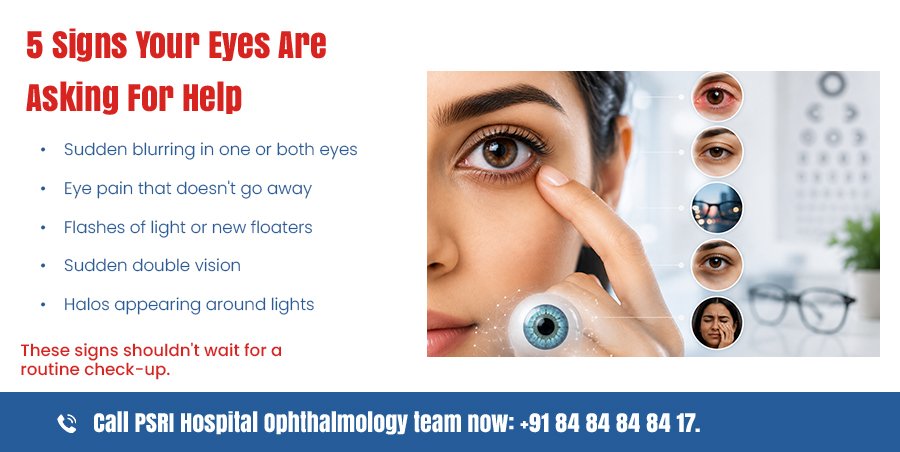
World Sight Day is a reminder, not just for patients abroad but for anyone nearby, that most vision loss gives warning signs long before it becomes permanent. The earlier someone comes in, the more options we usually have.
If it’s been more than a year since the last eye exam, or if any of the warning signs above sound familiar, there’s no need to wait for a special occasion to book one.
Call +91 84 84 84 84 17 to schedule a consultation with the PSRI Hospital Ophthalmology team.
Frequently Asked Questions
When is World Sight Day 2026?
World Sight Day 2026 lands on Thursday, October 8, always the second Thursday of October. That timing hasn’t changed since the day began in 2000.
How often should someone get their eyes checked?
Every one to two years for most adults, yearly once someone turns 40 or has diabetes. Kids need their eyes checked even earlier, and more often.
Can most vision loss actually be prevented?
Yes, most of it. The World Health Organization puts the preventable or treatable share at close to half of all vision impairment worldwide.
What does the Love Your Eyes campaign ask people to do?
Mainly, it asks people to get their eyes checked. Beyond that, it pushes for eye care that’s actually affordable and available to everyone, not just those who can already pay for it.